

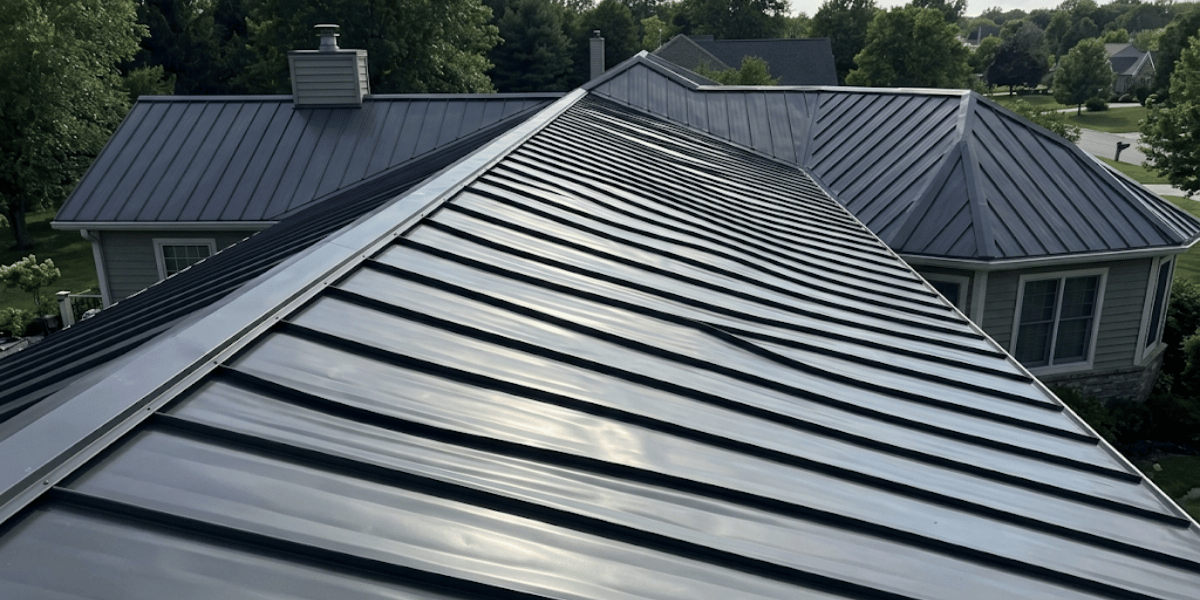
If you are standing in your driveway looking at waves in your new metal roof, the short answer is that your roof is almost certainly fine. Oil canning is the perceived waviness in the broad flat areas of a metal panel, it is inherent to light-gauge cold-formed metal, and it does not affect how the roof performs or whether it leaks. It is also not evenly distributed. Some panels show it badly and others barely show it at all, and that difference is decided before anyone climbs a ladder.
Key takeaways
- Oil canning is an aesthetic condition, not a structural defect, and the Metal Construction Association’s position is that it is not grounds for panel rejection.
- The industry standard for judging it is a view from 10 feet away, perpendicular to the surface, in natural light.
- Panel profile matters more than anything else you control. The narrower the flat between ribs, the less waviness shows.
- Over-driven fasteners are the most common preventable cause, and impact drivers are specifically not recommended for fastening metal panels.
What oil canning actually is
Oil canning is a visual effect rather than damage, and the mechanism is simple enough: the metal is buckling elastically across a flat span, the same way the bottom of an oil can flexes when you press on it, which is where the name comes from. Elastic buckling and stress wrinkling describe the same thing.
The Metal Construction Association defines it as perceived waviness in the flat areas of metal roofing and siding panels, and notes that the period and amplitude of the wave depend on the continuous width of the flat. That last part is the whole story in one sentence. Wider flat, more visible wave.
There is no standardized way to measure oil canning, which is why arguments about it tend to go nowhere: there is no gauge you can hold against a roof and no published tolerance you can point to. There is only whether it is visible, and visibility depends on where you happen to be standing and what time of day it is.
Why your roof and not your neighbor’s
Four things drive it, and you have progressively more control as you go down the list.
Coil condition. Flat steel is produced under rolling tension, and coils leave the mill with three characteristic conditions. Full center means the sheet is longer through the middle, which produces ripples down the centerline, and it is the most common. Wavy edge means the strip is longer at the edges. Camber is a side edge that deviates from straight, like the curve of a banana. Every coil has some of this, and it gets more pronounced in thinner and wider sheet.
Gauge. Thicker metal is stiffer and resists buckling better, and in roofing a smaller gauge number means thicker steel, so 26 gauge is stiffer than 29 and 24 is stiffer than 26. Every configuration we sell is tested and approved at a specific gauge, which you can verify in the Florida Product Approval database or on our approval codes page.
Panel profile. This gets its own section below, because it is the single biggest lever available to you.
Installation. Also below, because unlike the first three factors this one is entirely preventable and it is where the worst cases come from.
Slitting matters as well, because taking a wide coil and cutting it into narrower ones introduces its own stress, which is why tension leveling should be done after slitting rather than before it.
Panel profile is the biggest lever you have
The MCA draws a clean line here: profiles with wide flat surfaces, the ones usually called architectural, are distinguished from fluted or corrugated shapes that have much narrower flats and are less likely to exhibit oil canning.
Applied to what we manufacture, that produces an order nobody enjoys publishing:
| Panel | Rib spacing | Flat between ribs | How much it shows |
|---|---|---|---|
| Super Pro 5 Rib | 5 ribs, 9″ on center | narrowest | least |
| Super Pro PBR | 4 ribs, 12″ on center | moderate | more |
| Pro Loc Standing Seam | 16″ coverage | widest | most |
Pro Loc is our premium panel. It is a concealed-fastener standing seam system, it carries the longest finish warranty, and it costs the most, and it is also the panel on which you are most likely to see waviness. That is not a defect in our product, and it is not a reason to avoid standing seam. It is a consequence of geometry that applies to every standing seam panel made by anybody, and a buyer stepping up to the premium profile deserves to know it going in rather than discovering it some afternoon in August. The same trade-off shows up in our comparisons of R-panel versus standing seam and corrugated versus standing seam.
The reverse is worth saying just as plainly. If oil canning is the thing you care most about, our Super Pro 5 Rib in 26 gauge is a better choice than the more expensive panel, because 9 inches of flat cannot buckle the way 15 inches can. Our comparison of 5V, standing seam, and R-panel covers the rest of the trade-offs, and the full profile specs are on our roofing panels page.
The causes that are somebody’s fault
Three of the four factors above are physics and you work around them. Installation is not physics, and it is where most genuinely severe oil canning actually comes from.
Over-driven fasteners are the leading preventable cause. Crushing the washer pulls the panel down against the substrate and creates visible waves running along the fastener line. The MCA specifically recommends against using an impact driver to fasten metal panels, because an impact driver gives you no feedback at the moment the washer seats. Use a screw gun with an adjustable clutch or a depth gauge, set the torque on a scrap piece first, and walk the first row before you commit to running the whole roof.
Pinning the panel. Metal moves, and in Florida it moves a lot: a 20-foot panel goes through a surface temperature swing that expands and contracts it every single day of the year, and if both ends are fixed, that movement has nowhere to go except out into the flat. Standing seam systems use clips for exactly this reason, and sliding clips or slotted holes give the panel the room it needs.
Uneven decking or framing. Panels follow whatever is underneath them, so a deck that waves will produce a roof that waves, and no panel made is stiff enough to bridge across it.
Handling. This one surprises people, because it happens before the panel ever reaches the roof. Carrying a panel flat, or lifting it by a single corner off a stack, twists it, and a twisted panel does not return to flat on its own. Carry panels on edge, put two people on anything long, and never drag one off the top of a bundle by the corner.
Why it looks worse on some days
Oil canning is more apparent at certain times of day and in certain seasons, because it depends entirely on the angle at which light hits the surface. A roof that looks perfect at noon can look terrible at five in the afternoon when the sun rakes across it. The same roof in December looks different than it does in June.
Finish plays into this too. Gloss reflects more directional light and makes waviness easier to see, while lower-gloss and textured finishes diffuse it. Darker colors generally show it more than lighter ones.
This is why the call almost always comes a week or two after installation rather than on the day the crew leaves. Nothing changed on the roof. The sun moved.
So is it a defect?
The industry position is settled and it is not ambiguous. Unless specific flatness tolerances were written into the contract documents and accepted by both the supplier and the manufacturer, and provided reasonable precautions were taken, oil canning is not grounds for panel rejection. Finish warranties across this industry cover the coating, not the flatness of the substrate, so check your own warranty document, because oil canning is generally excluded from all of them.
There is one real exception and it deserves attention rather than dismissal. The MCA notes that extreme distortion should be reviewed, because it can indicate movement within the primary structure or distressed connections in the panel system. If the waves appeared suddenly on a roof that was flat for years, or if they are concentrated around a specific area rather than spread across the field, that is worth having somebody look at.
Here is the practical test, and it is the one the industry actually uses for architectural metal panels: stand 10 feet back, look perpendicular to the surface, in natural exterior light. The NRCA Roofing Manual covers the same territory for architectural metal. If you have to stand six feet away at a raking angle to find the waviness, your roof is within normal.
What can actually be done
Before you order: specify striations or stiffening ribs, which break up the flat and reduce how apparent the waviness is. Confirm that whatever you are quoted is approved in the configuration you are actually building, since gauge and substrate are both part of that approval. The honest caveat, straight from the MCA, is that striations can introduce minor shadow lines of their own. Step up a gauge. Choose a lower-gloss finish and a lighter color. Ask whether the coil is tension leveled, meaning it has been stretched past its yield point so it will not creep back toward its original shape.
During installation: flat decking, correct fastener torque, no impact drivers, panels handled on edge, clips that allow movement.
After installation: far less, which is the uncomfortable part. A backer rod taped to the back centerline of a panel can bulge it slightly and relieve internal stress, and shimming under clips can help in spots where the deck is uneven, but both are limited fixes that address symptoms. Nobody flattens a roof that is already on the building, and a contractor promising otherwise is selling you something.
Frequently asked questions
Is oil canning a defect?
No. It is an aesthetic condition inherent to light-gauge cold-formed metal, and the Metal Construction Association’s position is that it is not grounds for panel rejection absent contractual flatness tolerances. It is generally excluded from finish warranties, so read yours.
Does oil canning cause leaks?
No. It does not affect the structural or weathertight performance of a correctly installed panel. The exception is extreme distortion, which can signal a problem with the structure or the connections underneath and should be inspected.
Which metal roof panel oil cans the least?
Panels with narrow flats between closely spaced ribs. Our Super Pro 5 Rib, with ribs 9 inches on center, shows less than a wide-flat standing seam panel. Corrugated and fluted profiles generally show the least of all.
Can oil canning be fixed after installation?
Rarely, and only partially. Backer rods and shims under clips relieve some stress on some roofs. There is no method for flattening an installed roof, which is why panel and gauge selection before ordering matters so much.
Does thicker gauge stop oil canning?
It reduces it rather than stopping it. Thicker metal is stiffer and resists buckling, so 26 gauge shows less than 29 and 24 shows less than 26. Profile still matters more than gauge does.
Decide this before you order, not after
Panel profile, gauge, gloss level, and color all affect how much waviness you will see, and all four are free to change while your order is still a quote. Once the panels are rolled, your options narrow to shims and acceptance. Send us your roof dimensions and tell us how much this matters to you, and we will run a free CAD takeoff and give you a straight answer about which of our profiles fits what you want. Call 386-222-6779.