

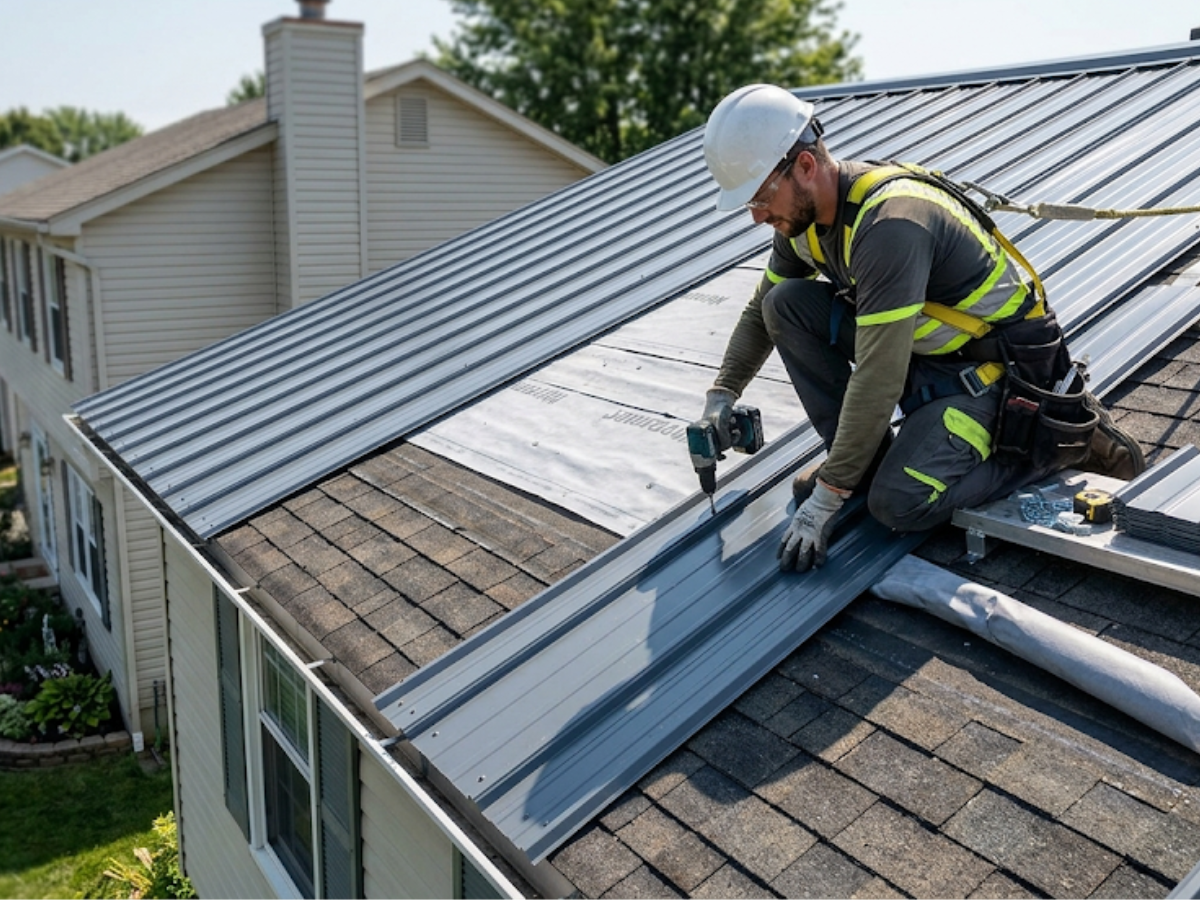
You can install a metal roof over a single layer of asphalt shingles in Florida if the existing roof has only one layer of covering, the deck is sound, and the structure carries the added load. Section 1511.3 of the Florida Building Code lists the conditions that force a tear-off instead. We see homeowners try to skip the tear-off to save on disposal and labor, which is a legitimate reason. We also see them lose wind mitigation credits and miss problems hiding under the existing roof. The right answer depends on the deck, the existing covering, and what you want out of the new roof.
Key takeaways
- Florida Building Code allows one re-cover for an existing single-layer asphalt shingle roof under Section 1511.3, provided the deck is sound and the structure can carry the load.
- Section 1511.3 includes a specific exception that benefits engineered standing seam systems like our Pro-Loc Standing Seam panel.
- The High-Velocity Hurricane Zone (Miami-Dade and Broward counties) operates under Section 1521, with stricter testing and inspection requirements that often push the project to a full tear-off.
- High-temperature self-adhered underlayment is the right choice under metal panels in Florida because of the heat that builds up beneath the panel.
- A re-cover keeps the existing deck attachment and substrate in place, which can cap the wind mitigation credits available on the OIR-B1-1802 form.
Does Florida code allow installing a metal roof over shingles?
Yes, in most jurisdictions, with conditions. Section 1511.3 of the Florida Building Code lays out exactly when you cannot install a new roof covering over an existing one. The code requires removal of all existing layers down to the deck where any of the following apply:
- The existing roof is water-soaked or has deteriorated to the point that it cannot serve as a base for additional roofing.
- The existing covering is wood shake, slate, clay, cement, or asbestos-cement tile.
- There are already two or more layers of covering on the roof.
- Blisters exist in the existing roofing (unless they are cut, scraped, and re-secured).
- The existing covering will be used to attach the new system but cannot meet the securement provisions of Section 1504.1.
If none of those apply, the code allows the re-cover. The structural load needs to be checked too: metal is lighter than tile but heavier than nothing, and the existing shingle layer stays in place under it.
There is one exception in 1511.3 worth knowing if you are considering a standing seam roof. The code carves out an allowance for “complete and separate roofing systems, such as standing-seam metal roof systems, that are designed to transmit the roof loads directly to the building’s structural system and that do not rely on existing roofs and roof coverings for support.” Translated: an engineered standing seam roof attached through the shingles directly to the deck does not necessarily require tear-off the way other systems might. Our Pro-Loc Standing Seam is an engineered standing seam system that fits this description.
What underlayment do you need for a Florida re-cover?
Florida heat under a metal panel is harder on underlayment than most people realize. The shingle layer underneath is not a substitute for a proper underlayment, and a felt paper rated for an asphalt shingle install will not hold up under a metal roof.
We default to a high-temperature self-adhered underlayment on Florida re-covers. There are two reasons. First, the rubberized asphalt seals around the panel fasteners as they go in, which matters more on a re-cover than a tear-off because the underlayment is the only continuous water barrier in the assembly. Second, the high-temperature rating handles the heat that builds up between the panel and the substrate during a Florida summer. A standard self-adhered membrane will soften and lose adhesion in that environment.
Synthetic underlayment is acceptable on many code paths and faster to install. The trade-off is that synthetics rely on the fastener pattern for water control, and on a re-cover the fasteners go through the shingle layer below.
When you should tear off instead
A re-cover saves money. It is not always the right call. Tear off the existing roof in any of these situations:
- Two or more existing layers of roof covering. Section 1511.3 requires it, and the structural load is the reason.
- Visible damage on the existing shingle roof: curling, missing tabs, sagging, moss growth that suggests trapped moisture.
- The home is approaching the threshold where insurers start scrutinizing roof age. Florida’s 15-Year Roof Rule under Florida Statute 627.7011 limits how an insurer can refuse renewal on age alone, but it does not require the carrier to ignore condition. The statute requires that for a roof 15 or more years old, an inspection showing at least 5 years of remaining useful life must be honored by the carrier.
- You want maximum wind mitigation credits. Several lines on the OIR-B1-1802 form, including secondary water resistance and verified deck attachment, are easier to document on a tear-off than a re-cover.
- The home sits in the HVHZ. Section 1521 of the FBC governs HVHZ reroofing, and a metal panel re-cover in HVHZ has to be installed under the panel’s Notice of Acceptance for HVHZ, which is more limiting than non-HVHZ approvals. Many local inspectors in Miami-Dade and Broward will simply require a tear-off rather than work through the HVHZ re-cover path.
The honest pitch on tear-offs: they reveal the deck. A re-cover hides it. If the deck has issues, you find out the hard way years later, after water finds the soft spot.
Furring strips, battens, and direct attachment
Florida re-covers usually fall into one of three setups: direct attachment to the shingles, furring strips, or battens. Direct attachment versus furring strips is its own conversation, and the right answer depends on the panel profile and how flat the existing shingle layer sits.
Direct attachment is fastest and cheapest. The risk is telegraphing, where the panel ridges show every irregularity in the shingle layer below. Furring strips, typically 1x4s installed horizontally through the shingles into the deck, create a vented gap and a flat plane for the panels. Battens are heavier and are used for some standing seam systems and when a vented assembly is required.
Our exposed-fastener panels, Super Pro 5 Rib, Super Pro 5V, and Super Pro PBR, all run over each of these substrates with the right fastener pattern. Pro-Loc Standing Seam runs on plywood substrate, so a standing seam re-cover usually means furring strips and a fresh deck plane, or a direct-to-shingle install where the engineering allows it.
How a re-cover affects your Florida wind mitigation credits
The OIR-B1-1802 wind mitigation form drives the credits your insurance carrier applies to your roof. Several of the high-value credits depend on what the inspector can verify under the roof covering: the deck attachment, the secondary water resistance, the roof-to-wall connections. A re-cover keeps the existing decking and the existing fastener pattern in place, which means the inspector cannot upgrade the deck attachment or add a secondary water barrier without first removing the roof covering.
Specific savings on the OIR-B1-1802 vary by carrier, by home, and by which credits the inspector can verify. A re-cover does not disqualify you from credits and it does not stop the form from being filed. It does cap how many of the higher-value credits you can claim. If your reason for reroofing is wind mitigation savings, the math usually favors a tear-off. We have seen the opposite happen too, where the project savings on a re-cover outweigh the credit difference. Talk to your insurance agent before you sign a contract.
A coastal warranty note
If your home is within 1,500 feet of salt water, the Valspar Weather XL paint system (the 40-year painted finish on most of our panels) warranty excludes you. The warranty document is specific about it. For coastal homes inside that boundary, we recommend either Pro-Loc Standing Seam in .032 aluminum or a PVDF/Kynar finish, both of which carry warranty terms appropriate to salt exposure. This is one of the questions worth asking before you spec the panel, not after.
What to do next
If you are unsure whether your Florida home is a good candidate for a re-cover, the simplest first step is a free CAD takeoff. Our team in Welaka pulls aerial imagery of the roof, calculates the square footage and waste factor, identifies the panel profile that fits the architecture, and produces a complete material list. Turnaround is 24 to 48 hours.
Request a free CAD takeoff at rpsmetalroofing.com or call 386-222-6779.
Frequently Asked Questions
Is it cheaper to put a metal roof over shingles in Florida?
Usually yes. The savings come from skipping tear-off labor and disposal, which typically run $1 to $2 per square foot of roof area in Florida. On a 2,000 square foot roof, that is $2,000 to $4,000 saved. The savings shrink if the contractor adds furring strips, or if the deck turns out to need repair underneath the shingles.
Will my Florida home insurance company allow a metal roof over shingles?
Most carriers will. Some require a full tear-off for the policy to credit the maximum wind mitigation discount. Confirm with your insurance agent before signing a contract. The OIR-B1-1802 form drives the credits, and a re-cover can limit how many you qualify for.
How many layers of shingles can be under a Florida metal roof?
One. Section 1511.3 of the Florida Building Code prohibits installing a new covering over a roof that already has two or more layers. If your roof has been re-covered once before, you tear off.
Does the Florida 15-Year Roof Rule apply to a metal re-cover?
Yes. Florida Statute 627.7011, often called the 15-Year Roof Rule, prevents an insurer from refusing renewal solely because your roof is 15 or more years old, provided an inspection by an authorized inspector certifies at least 5 years of remaining useful life. The new metal re-cover is what the inspector evaluates, not the shingle layer underneath.
Can I install a metal roof over shingles in Miami-Dade or Broward?
Rarely. Both counties sit in the HVHZ, governed by Section 1521. For metal panel re-covers, the panel system has to carry an HVHZ-specific Notice of Acceptance for the assembly, gauge, and substrate condition. Most HVHZ projects move to a full tear-off because the strip-and-replace path is simpler than working through the HVHZ re-cover requirements.
What about coastal homes near salt water?
If your home is within 1,500 feet of salt water, the Valspar Weather XL warranty does not cover the painted finish. For coastal Florida, we recommend Pro-Loc Standing Seam in .032 aluminum or a PVDF/Kynar finish, both of which have warranty terms designed for salt exposure.