

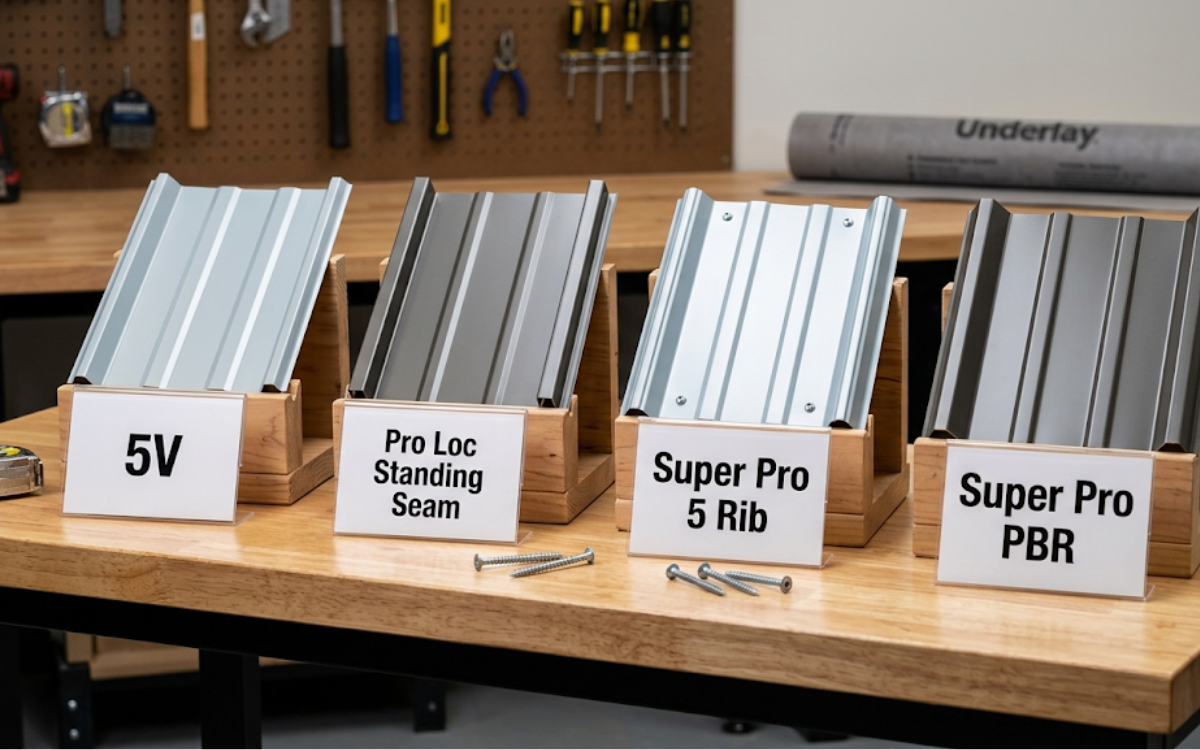
For most Florida residential and light-commercial work, the panel choice comes down to three families: 5V crimp for traditional residential and agricultural roofs, standing seam for high-end residential and any roof where the customer wants no exposed fasteners, and R-panel (which in RPS’s lineup splits into two products: Super Pro 5 Rib for general use and Super Pro PBR for longer spans and post-frame). Each panel has its own minimum slope per Section 1507.4.2 of the Florida Building Code, its own Florida Product Approval requirements, and its own application range. Picking the right one means matching panel to job, not defaulting to whatever your crew ran last week.
Key takeaways
- 5V crimp uses exposed fasteners through the flat between V-shaped crimps. Standing seam uses concealed clips under raised seams. R-panel uses exposed fasteners through trapezoidal ribs.
- Florida Building Code Section 1507.4.2 sets minimum slopes: 3:12 for lapped exposed-fastener panels without sealant, 1/2:12 with sealant, and 1/4:12 for standing-seam panel systems.
- Every panel installed in Florida needs a current Florida Product Approval. HVHZ jobs (Miami-Dade and Broward) need an HVHZ-specific Notice of Acceptance under Section 1521.
- Coastal jobs (within 1,500 feet of salt water) should run aluminum substrate or PVDF/Kynar finish; the Valspar Weather XL painted finish warranty excludes that boundary.
- RPS produces all three families in Welaka: Super Pro 5V, Super Pro 5 Rib, Super Pro PBR, and Pro Loc Standing Seam.
How the three profiles physically differ
The three families are not interchangeable. They differ in geometry, fastening method, panel coverage, and what they’re designed to sit on.
5V crimp is a 24-inch coverage panel with V-shaped crimps spaced across the width. Fasteners go through the flat between the crimps. The profile is shallow, the panel is light, and the look is the traditional Florida tin roof on rural homes, agricultural buildings, and Cracker-style architecture. Our Super Pro 5V is stocked in 26-gauge Galvalume mill finish, with 26-gauge SMP and PVDF and 24-gauge mill finish or PVDF available on request. Per the catalog spec, this panel is for residential and agricultural roofs. We do not spec it for commercial work.
Standing seam runs vertical panels with raised seams that interlock above the panel surface. Fasteners are concealed under the seam. Our Pro Loc Standing Seam is a 16-inch coverage panel with a striated face, available in 24-gauge and 26-gauge steel (galvalume or painted) and .032 aluminum painted. Pro Loc is positioned for residential building roofs over plywood substrate.
R-panel is an industry-generic term that in our lineup covers two distinct products:
- Super Pro 5 Rib is a 36-inch coverage panel with five ribs at 9 inches on center, 3/4-inch rib height. It comes in 29 and 26 gauge Galvalume. Residential, agricultural, and commercial use.
- Super Pro PBR is a 36-inch coverage panel with four ribs at 12 inches on center, 1 1/4-inch rib height. PBR (Purlin Bearing Rib) has a stouter bottom rib engineered to bear directly against a purlin without crushing under fastener load. It comes standard in 26 gauge with 24 gauge available on request, and it’s the panel we recommend for longer spans, post-frame buildings, and high loads. Residential, agricultural, and commercial use, including over open framing.
The correct R-panel for the job depends on the substrate and the span. For deck-supported residential and ag work, Super Pro 5 Rib does the job. For pole barns, post-frame, and any application where the panel sits directly on purlins or spans long distances, Super Pro PBR is the spec.
Florida Product Approval and uplift: the spec checklist before you order
Every panel installed on a Florida job has to carry a current Florida Product Approval number (FL #). The state runs a public database at floridabuilding.org. Three things to verify before ordering:
- The approval is current. Florida Product Approvals expire. An old number on a spec sheet may not be valid for today’s permit.
- The approval covers your application. A 26-gauge approval over plywood does not transfer to a 26-gauge install over open purlins. Verify the assembly, gauge, fastener pattern, and substrate match the job.
- The approval matches the wind zone. HVHZ jobs need an HVHZ-specific NOA. A non-HVHZ approval pulled into a Miami-Dade or Broward job will fail inspection.
Wind uplift ratings come from several test paths: ASTM E1592, TAS 125 for HVHZ, and UL 580 or UL 1897 for some commercial applications. The numbers depend on gauge, profile, fastener spacing, fastener type, and substrate. The same panel at 12-inch fastener spacing has a different uplift number than the same panel at 6-inch spacing. The product approval document spells out the exact pattern that earned the rating. Change the pattern, you lose the rating.
[PHOTO CALLOUT: Cross-section comparison of all four panel profiles staged at the Welaka facility, with 5V crimp, Pro Loc Standing Seam, Super Pro 5 Rib, and Super Pro PBR clearly labeled.]
When to spec 5V crimp
Spec 5V in three cases:
- Traditional Florida residential, especially Cracker-style and rural homes. The look matches the architecture. Customers in Putnam, Marion, St. Johns, and inland counties expect 5V on this type of home, and the architectural fit is part of why they’re buying metal in the first place.
- Agricultural buildings on a tight budget. The 24-inch coverage runs cheaper per square foot than standing seam, the fastener pattern is simple, and crews don’t need clips or seamers.
- Re-roofs over existing 5V. Match what’s there. Switching profiles changes the look and may require new substrate work.
Where 5V is not the right call: low-slope work below 3:12 per FBC 1507.4.2 (with-sealant exception drops it to 1/2:12, but most contractors won’t run 5V that low), commercial work, and HVHZ unless your panel’s NOA covers it for the gauge and assembly you plan to install.
When to spec standing seam
Pro Loc Standing Seam pays for itself in three scenarios:
- High-end residential. No exposed fasteners, no visible screw heads. The aesthetic matters to the customer paying the upgrade price.
- Lower-slope residential. Standing seam panel systems carry a 1/4:12 code minimum versus 3:12 for exposed-fastener systems. That’s a meaningful difference on architecturally low-slope homes. Note that Pro Loc’s actual published minimum may be more conservative than the code minimum, and we recommend confirming against the current spec sheet before designing to code minimums.
- Coastal jobs that want aluminum. Pro Loc is available in .032 aluminum, which sidesteps the substrate-corrosion conversation entirely on homes within 1,500 feet of salt water.
The trade-offs are cost and labor. Panels run more per square foot, the install requires clip layout and seaming, and crews not trained on standing seam will be slower than on 5V or R-panel. We don’t recommend Pro Loc for commercial low-slope industrial work; it’s positioned for residential building roofs over plywood, and that’s the job it does best.
When to spec R-panel: Super Pro 5 Rib vs Super Pro PBR
R-panel is the workhorse for agricultural, commercial, and post-frame Florida work. The choice between Super Pro 5 Rib and Super Pro PBR is the part most contractors get wrong.
Spec Super Pro 5 Rib for:
- Standard agricultural and light commercial buildings with deck-supported roof systems
- Residential applications where the customer wants the ribbed look at exposed-fastener pricing
- Re-roofs over existing 5-rib panels, where matching profile makes the trim and flashing details continue to work
Spec Super Pro PBR for:
- Pole barns, post-frame buildings, and any application where the panel sits directly on purlins
- Long spans where the heavier rib geometry matters structurally
- High-load applications, including snow regions outside Florida that ship from Welaka
- Wall panels over open framing, in addition to roof panels
The PBR rib is wider and 1/2 inch taller than the 5 Rib (1 1/4″ vs 3/4″). On a deck-supported job, that’s overkill. On open framing, it’s the difference between a panel that performs and one that crushes under fastener load over time.
Coastal vs inland: substrate, gauge, and finish
Florida is two markets for panel finish. A working contractor rule: treat anything within 1,500 feet of salt water as coastal exposure. That number isn’t arbitrary. The Valspar Weather XL painted finish warranty (the 40-year SMP system on most of our painted panels) explicitly excludes substrates installed within 1,500 feet of a salt-water environment. If you spec Weather XL on a coastal home and salt corrosion compromises the finish, the warranty doesn’t cover it.
For coastal jobs (within 1,500 feet of salt water): spec aluminum substrate (Pro Loc Standing Seam .032), or specify PVDF/Kynar finish with a coastal-rated warranty. Aluminum sidesteps the substrate corrosion question. PVDF holds color and chalk resistance better than SMP under sustained UV and salt exposure.
For inland jobs: Galvalume with Valspar Weather XL is fine. The cost savings versus Kynar are real, the 40-year warranty is appropriate, and the color palette is broader.
Gauge upgrades follow the same logic. A coastal panel in 24 gauge holds up better than the same panel in 26 gauge in high-wind, salt-heavy environments, even when the FL Product Approval permits 26 gauge. The upcharge is small. The callbacks are not.
Need a takeoff?
If you want a CAD takeoff with the right panel profile already mapped to the architecture and the wind zone, our team in Welaka turns them in 24 to 48 hours. Panel quantity, trim, fastener spec, and FL Product Approval reference all listed. Request a free CAD takeoff at rpsmetalroofing.com or call 386-222-6779.
Frequently Asked Questions
What gauge should I spec for a Florida coastal home?
For coastal residential, 26 gauge is the practical minimum and 24 gauge is the safer call. 24 gauge handles wind cycling and accidental impact (palm fronds, debris) better than 26 gauge. The gauge upcharge is modest. The labor to repair a damaged panel later is not. In Pro Loc, .032 aluminum is the coastal-preferred substrate when finish warranty matters more than cost.
Can I install 5V crimp in HVHZ?
Sometimes, depending on the gauge, substrate, and the specific Notice of Acceptance for the assembly. Most HVHZ jobs go to standing seam or to PBR with an HVHZ-specific NOA. Before committing to 5V on an HVHZ job, pull the current FL Product Approval document for the gauge and substrate you plan to install and verify HVHZ coverage line by line.
What is the lowest pitch a standing seam roof can handle?
Section 1507.4.2 of the Florida Building Code sets the code minimum for standing-seam panel systems at 1/4:12 (2% slope). Manufacturer-specific minimums are often more conservative, especially for snap-lock systems versus mechanical-lock systems. Verify Pro Loc’s published minimum against the current spec sheet before designing to the code minimum.
Which of the three has the highest wind uplift rating?
There is no universal answer. The same panel at different gauges, fastener patterns, and substrates carries different uplift numbers. Mechanical-seam standing seam tends to lead in low-slope commercial. PBR hits high numbers on engineered post-frame jobs. 5V uplift depends heavily on fastener spacing and substrate. Pull the FL Product Approval for the exact panel, gauge, fastener pattern, and substrate on your job.
Are R-panel and PBR the same thing?
Closely related, not identical. R-panel is the industry-generic term. PBR (Purlin Bearing Rib) is a specific variant with a stouter, taller rib geometry engineered to bear directly against a purlin without crushing. In our lineup, Super Pro 5 Rib is the standard R-panel; Super Pro PBR is the post-frame variant. For deck-supported installs, either works. For open-purlin installs, spec PBR.
How do I find the Florida Product Approval number for a specific RPS panel?
Two paths. First, the RPS approval codes page lists current FL # references organized by panel and gauge. Second, search the Florida Building Commission’s Product Approval database directly. Either should give you the same FL #, but the floridabuilding.org listing is the official record.
Does HB 293 affect what panel I can spec on an HOA-controlled home?
Yes, in some cases. HB 293 (2024), the Hurricane Protections for Homeowners’ Associations law, limits how an HOA can deny a hurricane-protective roof system that meets adopted specifications and Florida Building Code. For metal roofs that meet hurricane standards (and ours do, per current Florida Product Approval), HOAs cannot blanket-prohibit the system, though they can still regulate color and style for aesthetic uniformity. If your customer is in an HOA community that previously denied metal roofs, this is the law that opens the door.