

For most Florida residential and agricultural metal roofs, Galvalume is the right substrate. Its 55% aluminum, 43.4% zinc, and 1.5% silicon coating outlasts traditional galvanized steel by a factor of two to four under typical atmospheric exposure, which is why it’s the industry-standard substrate for unpainted metal roof panels. Galvanized steel still has its place: animal confinement buildings, industrial uses, fencing, and applications where the higher zinc content matters more than corrosion-resistance longevity. The decision is not about which metal is “better” overall. It’s about matching the coating to the application.
This is a substantial 2026 rewrite of an earlier post on this URL. We’ve corrected several factual issues from the previous version, added Florida-specific guidance (warranty exclusions, coastal exposure, RPS panel substrates), and brought the content up to current 2026 industry data.
Key takeaways
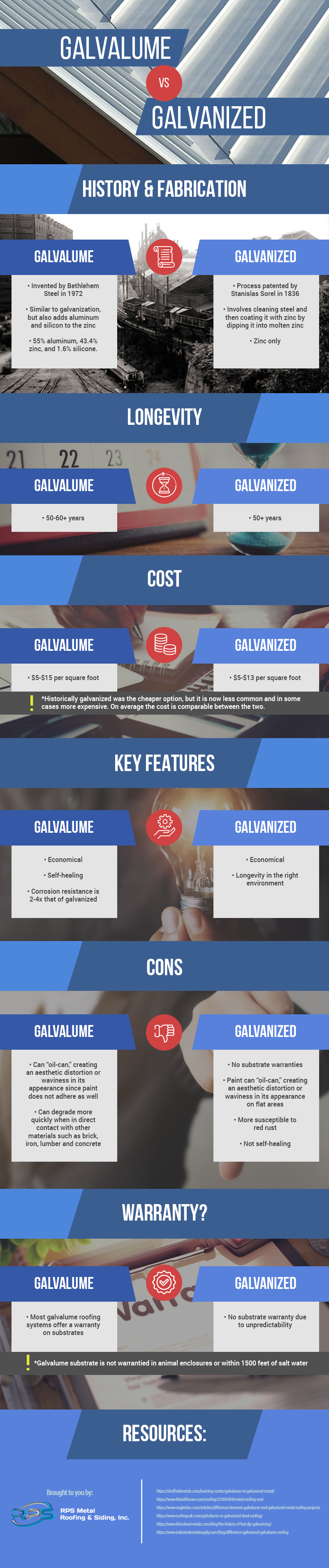
- Galvalume coating composition: 55% aluminum, 43.4% zinc, 1.5% silicon, applied via continuous hot-dip process. Invented by Bethlehem Steel in the late 1960s and commercialized in 1972, now licensed worldwide by BIEC International.
- Galvanized steel coating: Pure zinc, applied via hot-dip galvanizing. Older technology, well-understood, lower-cost.
- Corrosion resistance: Galvalume outlasts galvanized by approximately 2 to 4 times under typical atmospheric exposure, per Metal Construction Association research.
- Standard substrate warranty: Galvalume carries a 25 to 25.5-year substrate warranty under typical conditions. Galvanized warranties are usually shorter.
- Coastal exclusion: Both Galvalume and galvanized warranties exclude installations within approximately 1,500 feet of salt water. For Florida coastal homes inside that boundary, aluminum substrate is the recommended choice regardless of the coating.
- What RPS uses: All four RPS panel lines (Super Pro 5V, Super Pro 5 Rib, Super Pro PBR, Pro Loc Standing Seam) are produced on Galvalume substrate. Pro Loc Standing Seam is also available in .032 aluminum for coastal jobs.
What Galvalume actually is
Galvalume is a registered trademark of BIEC International Inc., the licensing body that owns the technology behind 55% aluminum-zinc alloy-coated steel sheet. The product was invented in the late 1960s by Angelo Borzillo and Jim Horton at Bethlehem Steel’s research labs in Bethlehem, Pennsylvania. After several years of testing different aluminum-to-zinc ratios in small lab pots holding six pounds of metal at a time, Borzillo and Horton arrived at the formula that’s still used today: 55% aluminum, 43.4% zinc, 1.5% silicon. Bethlehem commercialized the product in 1972, and cumulative global production has now exceeded 220 million tons.
The science behind why the formula works is straightforward. Zinc is a sacrificial anode: it corrodes preferentially to steel, which is what gives traditional galvanized coatings their corrosion protection. But pure zinc coatings have a finite life, and once the zinc is gone, the steel underneath rusts. Aluminum, on the other hand, forms a passive oxide layer that acts as a barrier rather than a sacrificial coating. By combining 55% aluminum with 43.4% zinc, Galvalume gets the best of both: the long-life barrier protection of aluminum plus the cut-edge sacrificial protection of zinc. The 1.5% silicon controls a brittle intermetallic layer that would otherwise form during manufacture, per BIEC’s published technical specifications.
For a metal roof manufacturer like RPS, that combination is the reason Galvalume has been the default substrate for unpainted residential and light-commercial panels for the better part of fifty years.
What galvanized steel is
Galvanized steel is older and simpler. Steel is dipped in molten zinc in a continuous hot-dip process, which leaves a layer of pure zinc on the surface. The zinc protects the steel by corroding first (the sacrificial anode mechanism described above), and the spangled appearance you sometimes see on galvanized fence posts and roofing is the crystallization pattern that forms as the zinc cools.
Galvanized coatings are specified by weight: G60 means 0.60 ounces of zinc per square foot of panel surface, G90 means 0.90 ounces. Heavier coatings last longer. The Galvalume equivalent specifications are AZ50 (0.50 ounces of aluminum-zinc alloy per square foot, the standard for painted products) and AZ55 (0.55 ounces, used for bare unpainted panels).
The weight numbers are not directly comparable between the two products. The aluminum-zinc alloy in Galvalume is roughly half the density of pure zinc, so an AZ50 Galvalume coating is actually a thicker layer than a G50 galvanized coating would be even though the per-square-foot weight is identical.
Galvalume vs galvanized: the practical comparison
| Galvalume | Galvanized | |
|---|---|---|
| Coating composition | 55% Al, 43.4% Zn, 1.5% Si | ~99% Zn |
| Standard coating weight | AZ50 (painted), AZ55 (bare) | G60 to G90 |
| Substrate warranty | ~25 years (atmospheric) | Typically shorter |
| Corrosion resistance vs the other | 2 to 4x longer service life | Baseline |
| Cut-edge performance | Self-healing (zinc sacrificial protection) | Self-healing (zinc sacrificial protection) |
| Coastal warranty (within 1,500 ft of salt water) | Excluded | Excluded |
| Animal confinement | Not recommended (ammonia attacks the coating) | Acceptable with ventilation |
| Cost | Higher | Lower |
| Best for | Most metal roofing, most siding | Animal buildings, fencing, industrial, structural |
The decision rule we use at RPS: unless the application is animal confinement, fencing, or a specific industrial use where the cost savings of galvanized matter more than the longevity of Galvalume, Galvalume wins.
Why Galvalume coatings outlast galvanized
Three reasons, in order of importance.
Aluminum forms a stable barrier oxide layer. Pure zinc is a sacrificial protector: it gives up electrons to protect the steel, and over years of atmospheric exposure, the zinc gradually erodes away. Aluminum oxidizes too, but the oxide layer it forms is dense, adherent, and self-passivating. Once that oxide layer is in place, further corrosion essentially stops. Galvalume’s 55% aluminum content gives it a barrier-protection mechanism that pure zinc galvanizing simply doesn’t have.
Galvalume gets the zinc benefit at exposed cut edges. When a panel is cut, sheared, or scratched through the coating, the steel underneath is exposed. Pure aluminum coatings would have no defense at the exposed edge: the steel would rust. Galvalume’s 43.4% zinc content keeps doing what zinc has always done: it sacrificially protects the exposed steel at the cut edge. That zinc content is what gives Galvalume its self-healing characteristic at panel edges and small scratches.
Industry data supports the durability claim. Metal Construction Association research indicates that Galvalume roofing can last 40 to 50 years or more under typical atmospheric exposure without significant corrosion. By comparison, traditional galvanized roofing tends to show meaningful corrosion in 10 to 25 years depending on coating weight and exposure conditions.
Where Galvalume is the right choice
For metal roofing and siding in Florida, the answer is almost always Galvalume. Specifically:
- Residential metal roofs outside the 1,500-foot coastal warranty boundary
- Agricultural buildings where livestock are not housed under the roof
- Light commercial roofing, including warehouses, retail buildings, and post-frame structures
- Trim, flashing, and accessories that match the panel substrate
- Wall panels where corrosion resistance matters
All four RPS panel families are manufactured on Galvalume substrate as standard: Super Pro 5V (residential and agricultural), Super Pro 5 Rib (residential, agricultural, and commercial), Super Pro PBR (post-frame and high-load applications), and Pro Loc Standing Seam (residential over plywood). For most Florida jobs, this is the substrate decision already made for you.
Where galvanized still wins
Galvalume isn’t right for everything. Three categories where galvanized steel is the better call:
Animal confinement buildings. This is the exception we always flag for agricultural customers. Animal manure produces ammonia gas as it decomposes, and ammonia chemically attacks the aluminum component of the Galvalume coating, causing premature failure. Galvanized steel handles ammonia far better. For chicken houses, hog barns, dairy operations, and similar buildings where livestock are housed under the roof, galvanized is the right substrate. The exception inside this exception: a properly ventilated chicken house with a vapor barrier between the chicken area and the roof can sometimes accept Galvalume, but this is a manufacturer-specific decision that should be confirmed before ordering.
Fencing and outdoor enclosures. The cost premium for Galvalume usually isn’t justified on chain-link fencing, livestock fencing, or similar applications where the corrosion resistance of pure zinc is sufficient and the budget is the constraint.
Structural steel and infrastructure. Beams, columns, guardrails, and other heavy structural components are typically galvanized rather than Galvalume-coated. The mechanical strength of the underlying steel matters more than the coating longevity, and galvanizing is the well-understood, code-supported standard for structural applications.
The Florida-specific question: Galvalume vs aluminum on the coast
This is where the comparison gets harder, and where the existing industry guidance is mixed.
Both Galvalume and galvanized warranties exclude installations within approximately 1,500 feet of salt water. Inside that boundary, Galvalume substrate is no longer warranted, and the same is true of galvanized. The recommended substitution is aluminum.
Aluminum substrate (the actual base metal of the panel, not just an aluminum coating on a steel core) is naturally rust-proof because there’s no steel underneath to rust. The aluminum oxide layer that forms on the surface acts as a permanent barrier. Aluminum panels carry paint warranties that remain valid in coastal applications where Galvalume warranties have already excluded coverage.
The trade-offs:
- Aluminum is roughly 80 to 100% more expensive than Galvalume substrate, per industry pricing surveys
- Aluminum is mechanically softer than steel, which matters more on long commercial panel runs than on residential roofs
- Aluminum and Galvalume use the same paint systems (Valspar Weather XL for SMP, Kynar 500 for PVDF), so finish performance is comparable
The decision rule for Florida coastal homes: if your home is within 1,500 feet of salt water, spec Pro Loc Standing Seam in .032 aluminum rather than any Galvalume option. The substrate cost premium is real, but the warranty coverage and corrosion-resistance gap are real too.
For homes a few miles inland from open salt water, Galvalume with a quality PVDF or Valspar Weather XL finish performs reliably and the cost premium for aluminum isn’t justified.
What about painted Galvalume?
The Galvalume substrate is what’s underneath. The paint is what’s on top. Most painted residential metal roofs use one of three paint systems on a Galvalume substrate:
- Valspar Weather XL is a silicone-modified polyester (SMP) system that carries a 40-year painted finish warranty under typical atmospheric conditions. This is the standard finish on most RPS painted residential panels. The Valspar Weather XL warranty excludes installations within 1,500 feet of salt water.
- PVDF/Kynar 500 is a fluoropolymer paint system that holds color and chalk resistance better than SMP under sustained UV exposure. Typically a 30-year painted finish warranty, with coastal-rated coverage available on aluminum substrate.
- Bare Galvalume (unpainted) uses an acrylic film coating to prevent scuffing during installation and shipping. Unpainted Galvalume gradually develops a matte gray patina over time and remains corrosion-resistant for the substrate’s lifetime.
The paint system and the substrate are independent decisions. You can pair Valspar Weather XL with Galvalume (the standard combination), or pair Kynar with aluminum (the coastal recommendation), or specify bare Galvalume where the natural metallic look fits the architecture. Your panel manufacturer’s color and finish chart will spell out which combinations are available for which products.
Choosing between Galvalume and galvanized: a quick decision rule
Three questions to ask:
- Is the building housing livestock? If yes, galvanized. If no, continue.
- Is the building within 1,500 feet of salt water? If yes, neither Galvalume nor galvanized is the right answer. Spec aluminum substrate. If no, continue.
- Is this a structural, fencing, or industrial application where coating longevity matters less than initial cost? If yes, galvanized may make sense. If no, Galvalume.
For typical residential and light commercial metal roofing in Florida, Galvalume is the right answer to almost every question. That’s why we manufacture our panel lines on Galvalume substrate as standard.
What to do next
If you’re not sure which substrate fits your specific Florida job, request a free CAD takeoff from our team in Welaka. We pull aerial imagery of the roof, calculate the square footage and waste factor, identify the panel profile that matches the architecture, and recommend the substrate and finish based on your location relative to salt water and the building’s use case. Turnaround is 24 to 48 hours.
Request a free CAD takeoff at rpsmetalroofing.com or call 386-222-6779.