

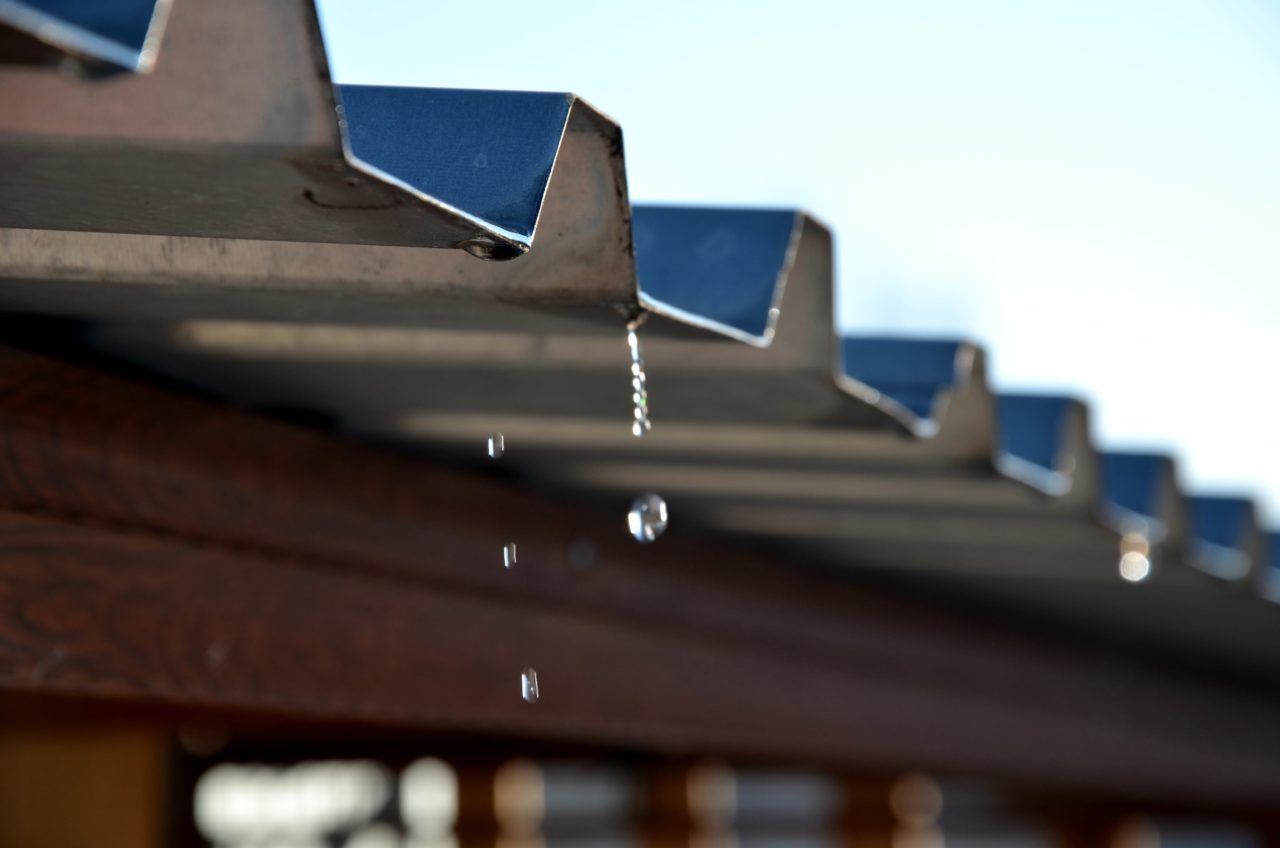
A drip edge is a metal flashing installed at the rake (sloped edge) and eave of a roof to direct water off the deck and away from the fascia. A gutter apron is a metal flashing installed at the eave specifically to direct water from the roof into the gutter without letting it run behind the gutter. Most Florida residential roofs need both. The drip edge handles the rake edges and the eave on roofs without gutters. The gutter apron handles the eave where the gutter is attached. They solve different parts of the same water-management problem.
This is a 2026 rewrite of an earlier post on this URL. The previous version had several factual issues we’ve corrected, including the geometry of drip edges for metal roofing and the relationship between these two trim pieces. We’ve added Florida Building Code citations, current RPS product specifications, and the Florida-specific guidance that was missing.
Key takeaways
- Drip edge: flashing installed at eaves and rakes to direct water off the roof deck; required by FBC Section R905.2.8.5 for shingle roofs in Florida. Metal roof manufacturers including RPS form it from the same metal as the panel for color and material consistency.
- Gutter apron: L-shaped flashing installed at the eave above the gutter to direct water into the gutter rather than behind it. Not always required by code but a best-practice install for any roof with gutters.
- You typically use both. Drip edge at rakes (and at eaves without gutters). Gutter apron at eaves where the gutter is attached. They are not alternatives.
- Florida high-wind fastener spacing: drip edges and edge metal must be mechanically fastened at 4 inches on center where the design wind speed (Vasd) is 110 mph or higher or the mean roof height exceeds 33 feet. Most of Florida triggers this requirement.
- RPS forms eaves drip and gable (rake) trim in matching gauge, finish, and color to the panel. Standard products include the Eaves Drip Bull Nose trim profile, gable trim, and other edge accessories.
What a drip edge actually is
A drip edge is a piece of flashing installed along the edge of the roof to do two things: direct water off the roof deck (so it falls clear of the fascia rather than running back against it) and seal the gap between the roof covering and the fascia (so water, wind-driven rain, and pests have a harder time getting under the roof).
For metal roofing in Florida, drip edge is typically formed from the same metal as the panel: Galvalume, aluminum, or painted steel, in matching gauge and finish. Mixing materials at the edge invites galvanic corrosion (where two dissimilar metals in contact corrode each other), so a Galvalume panel gets a Galvalume drip edge, an aluminum panel gets an aluminum drip edge, and so on.
The geometry varies by manufacturer and panel type. Some drip edge profiles are simple L-shapes. Others, like our Eaves Drip Bull Nose trim, are more involved. The RPS Eaves Drip Bull Nose has a 4-inch top leg that lays on top of the deck under the underlayment, a 2 1/2-inch face that extends down past the fascia, a 0.500-inch kick-out that throws water clear, and a 0.437-inch hem that closes the bottom edge for a clean finished look. The kick-out matters: it’s what physically directs water away from the fascia rather than letting it cling to the underside and wick back.
The previous version of this post described drip edge as “T-shaped” and said it could be made of “fiberglass plastic, vinyl, or aluminum.” That’s not accurate for metal roofing. T-shaped drip edges exist (sometimes used on asphalt shingle roofs), but most metal roof drip edges are L-shaped or modified L-shaped with a kick-out, formed from the same metal as the roof itself.
What a gutter apron is
A gutter apron is an L-shaped flashing installed at the eave specifically to bridge the gap between the roof’s edge and the back of the gutter. Without one, water running off a metal roof can drip behind the gutter (especially in heavy rain or wind-driven conditions), where it then runs down the fascia and behind the gutter board, causing rot and staining over time.
The L-shape is doing one job: take water that would otherwise drip into the gap between the roof edge and the gutter, and physically guide it forward into the gutter. The horizontal leg of the L lays on the roof deck under the underlayment (or sometimes over the underlayment, depending on installation method); the vertical leg extends down behind the gutter and inside the gutter’s back edge.
Gutter aprons are sometimes confused with drip edge because they look similar from a distance. The functional difference is where the bottom edge of the flashing terminates. A drip edge at the eave terminates outside the gutter, throwing water clear. A gutter apron terminates inside the gutter, dropping water directly into the trough.
Why most Florida homes need both
The terminology gets confused because both pieces are “edge metal” and both manage water at the eave. But they’re not interchangeable, and on a typical residential metal roof in Florida, you need both.
Here’s the breakdown by location on the roof:
| Location | Trim piece | Why |
|---|---|---|
| Rake (gable end, sloped edge) | Drip edge / gable trim | Directs water off the rake edge; no gutter at the rake |
| Eave with gutter | Gutter apron | Directs water from roof into gutter, not behind it |
| Eave without gutter | Drip edge | Throws water clear of the fascia |
| Sections where eave gutter ends | Drip edge transitions to gable trim | Continuous edge metal around the entire roof perimeter |
A roof installation that uses only drip edge and skips the gutter apron typically ends up with water running behind the gutter in heavy rain. A roof installation that uses only gutter apron and skips drip edge at the rake leaves the gable end exposed. Both pieces are doing real work; they’re not redundant.
What Florida code actually requires
Florida Building Code Section R905.2.8.5 (in the residential code) and the parallel Section 1507.2.9.3 (in the building code) set the drip edge requirements for shingle roofs. The 2023 8th Edition (in effect since December 31, 2023) specifies:
- Drip edge required at eaves and gables of shingle roofs.
- Overlap minimum 3 inches at adjacent pieces.
- Eave drip edges extend 1/2 inch below sheathing and back onto the roof a minimum of 2 inches.
- Mechanical fastening at maximum 12 inches on center.
- High-wind exception: where the design wind speed (Vasd, per Section 1609.3.1) is 110 mph or higher OR the mean roof height exceeds 33 feet, drip edges must be fastened at maximum 4 inches on center.
The high-wind exception covers most of Florida. Florida design wind speeds run from roughly 130 mph in the northern parts of the state to 180+ mph in the High-Velocity Hurricane Zone (Miami-Dade and Broward). Almost any Florida residential roof will hit the 4-inch fastener spacing requirement, not the standard 12-inch.
Metal roof installations are governed by FBC Chapter 15 and the panel system’s Florida Product Approval, and edge metal requirements are typically spelled out in the panel manufacturer’s installation instructions and the Notice of Acceptance. The code requirements above are written for shingle roofs but the high-wind fastening principle applies broadly to any edge metal in a hurricane zone: more frequent fastening, more secure attachment, less to come loose during a wind event.
The previous version of this post mentioned “strict regulations” and “building codes” without citing any specific section. We’ve added the actual code references because Florida contractors and homeowners both need them when permitting and during inspection.
Material and durability considerations
For metal roofs in Florida, the substrate decision for drip edge and gutter apron matches the panel substrate decision:
- Galvalume drip edge and gutter apron pair with Galvalume panels for inland Florida residential and agricultural work. Standard 26-gauge or 24-gauge formed steel with the 55% aluminum, 43.4% zinc, 1.5% silicon coating that gives Galvalume its 25-year typical substrate warranty.
- Aluminum drip edge and gutter apron pair with aluminum standing seam or aluminum panels for coastal jobs within 1,500 feet of salt water. This is where the Valspar Weather XL warranty exclusion takes effect on coated steel, and aluminum substrate sidesteps the corrosion issue entirely.
- Painted finish (Valspar Weather XL or PVDF/Kynar 500) matches the panel color so the edge metal blends rather than highlighting itself.
Mixing metals at the edge is the durability mistake we see most often. Putting a galvanized drip edge against a Galvalume panel, or an aluminum gutter apron against a steel-substrate panel, sets up galvanic corrosion at every contact point. The cost difference between matched and unmatched edge metal is usually small. The cost of the callbacks isn’t.
Installation order and the underlayment question
Per FBC R905.2.8.5 (2023 edition), drip edge at the gables is installed over the underlayment. Drip edge at the eaves can be installed either over or under the underlayment, with two conditions:
- If the drip edge is installed over the underlayment, a self-adhering ASTM D1970 underlayment may be installed over a primed drip edge flange.
- A minimum 4-inch width of roof cement must be installed over the drip edge flange or the self-adhering underlayment.
For metal roof assemblies, the actual installation sequence is set by the panel system’s Notice of Acceptance, not by the shingle-roof code. But the principle (drip edge at gables over underlayment, eaves can vary) applies broadly. Your panel manufacturer’s installation manual and the FL Product Approval document for the specific panel are the controlling references.
For gutter aprons, installation typically follows the underlayment: the apron sits on the roof deck under or over the underlayment depending on the assembly, with the front leg extending into the gutter trough.
Substrate and color matching
Edge metal that matches the panel does three things at once: it reduces galvanic corrosion risk, it gives the roof a finished appearance, and it simplifies inventory because the same material runs through panels and trim.
We form drip edge, gutter apron, gable (rake) trim, valley trim, transition trim, and ridge cap from the same coil stock as the panels. Order a Galvalume Super Pro 5 Rib roof in Brilliant Bronze and the trim arrives in Galvalume substrate, Brilliant Bronze paint, in matching gauge. This is one of the practical reasons to source panels and trim from a single manufacturer rather than mixing suppliers.
What to do next
If you’re not sure what edge metal package your Florida job needs, our team in Welaka pulls the trim list as part of every CAD takeoff. We identify the panel profile, calculate the linear footage of eaves, rakes, valleys, and transitions, recommend the trim profiles that match the panel (including the Eaves Drip Bull Nose for eaves and matching gable trim for rakes), and put the entire package on a single material list. Turnaround is 24 to 48 hours.
Request a free CAD takeoff at rpsmetalroofing.com or call 386-222-6779.
Frequently Asked Questions
Do I need both a drip edge and a gutter apron?
For most Florida residential metal roofs, yes. Drip edge handles the rake (gable) edges and any eave sections without gutters. Gutter apron handles eave sections where the gutter is attached, directing water from the roof into the gutter rather than behind it. They’re not alternatives; they handle different parts of the roof perimeter.
Is drip edge required by Florida code?
Yes, for shingle roofs. FBC Section R905.2.8.5 requires drip edge at eaves and gables of shingle roofs, with specific fastener spacing requirements (12 inches on center standard, 4 inches on center where Vasd is 110 mph or higher or the mean roof height exceeds 33 feet). For metal roofs, edge metal requirements are spelled out in the panel system’s Notice of Acceptance and the manufacturer’s installation manual.
Can I install a metal roof without a drip edge?
Not in Florida, in practice. While the explicit code requirement is written for shingle roofs, every Florida Product Approval for a metal panel system includes edge metal requirements as part of the assembly. Skipping drip edge or gable trim would put the install outside the approval, would fail inspection, and would invite water damage at the fascia within a few rain events.
What’s the difference between a gutter apron and just a wider drip edge?
The functional difference is where the bottom edge terminates. A drip edge at the eave terminates outside the gutter, throwing water clear of the fascia. A gutter apron terminates inside the gutter trough, dropping water directly into the gutter. A wider drip edge can sometimes do double duty on simple installations, but a properly installed gutter apron does the gutter-direction job better.
What material should drip edge and gutter apron be made from?
For a metal roof, match the substrate of the panel. Galvalume drip edge and gutter apron pair with Galvalume panels (most inland Florida residential and agricultural). Aluminum drip edge and gutter apron pair with aluminum panels (Florida coastal jobs within 1,500 feet of salt water). Mixing metals at the edge invites galvanic corrosion. Paint finish should match the panel color for both performance and appearance.
How often does Florida code require drip edge to be fastened?
Maximum 12 inches on center standard. Where the design wind speed (Vasd) is 110 mph or higher, or the mean roof height exceeds 33 feet, the requirement tightens to maximum 4 inches on center. Most Florida residential and commercial roofs meet one of these conditions, so 4-inch fastener spacing is the practical default for Florida edge metal installation.
Does RPS make matching drip edge and gutter apron for its panels?
Yes. We form drip edge (the Eaves Drip Bull Nose profile), gutter apron, gable trim, valley trim, ridge cap, and other edge accessories from the same coil stock as our panels. Order a Galvalume Super Pro 5 Rib roof in a specific color and the matching trim ships in the same substrate, gauge, and finish.