

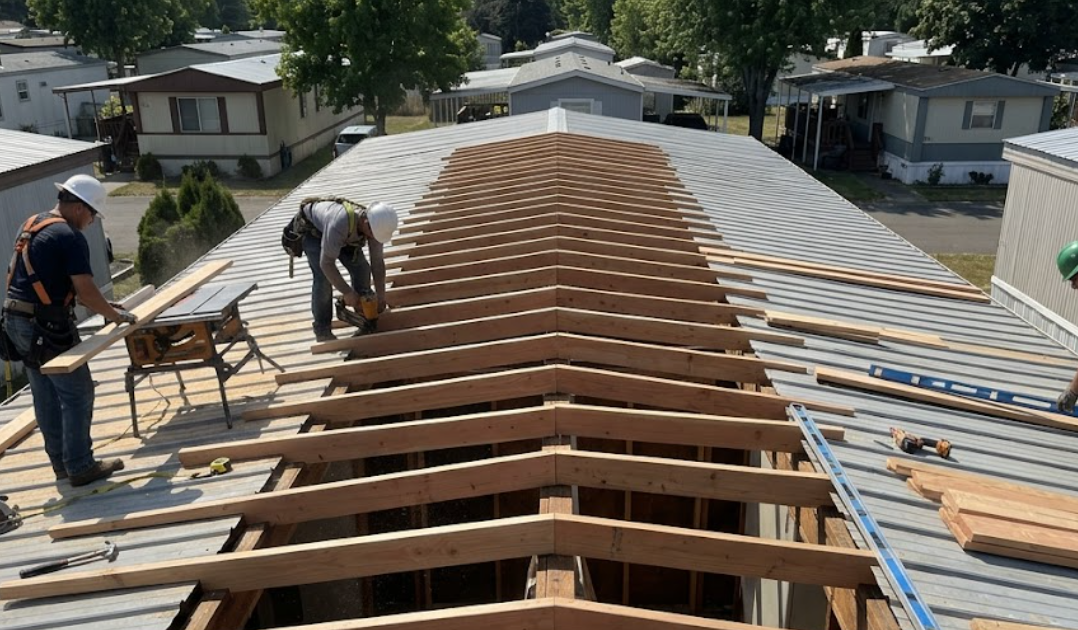
Replacing the roof on a Florida mobile home runs roughly $1,000 to $21,000, and that spread is not a dodge. It is the honest range once you account for the two variables that actually decide the number: which covering the roof’s slope will accept, and whether you are paying to build slope before anything goes down. A single-wide with a coating and a double-wide with a framed metal re-cover are both called a roof replacement, and they are twenty thousand dollars apart.
What you are actually paying for
A roof quote on a manufactured home is five line items wearing one number, and knowing which five is how you tell a complete bid from a thin one that will grow later.
Tear-off, or not. Removing the old covering and hauling it away costs about $1 to $4 per square foot, and a roof-over skips it entirely. That saving is real. It is also the single biggest reason people commit to a roof-over before asking the harder questions about what is underneath.
Framing. If the roof does not have the slope the covering requires, somebody has to build it, and that work is priced across the whole roof rather than in one corner. This line is invisible in most quotes and it is frequently the largest one in the job.
Underlayment. On a metal re-cover, a high-temperature peel-and-stick membrane or a radiant barrier goes down before any panel does, and skipping it to save a few hundred dollars is a decision you feel in August.
The covering itself. Coating, membrane, shingle, or panel.
Trim, penetrations, and edges. Vents, the eave and gable details, and every pipe boot, all of which cost the same whether the roof is large or small. A manufactured home usually carries more penetrations per square foot than a site-built house, so this line runs proportionally higher.
Cost by material
These are installed ranges drawn from Florida and national contractor pricing, and they assume a contractor does the work. Buying materials direct and hiring your own labor moves you toward the bottom of each range, which is the whole reason our Florida metal roof cost breakdown separates material from installed price.
| Covering | Installed, per sq ft | Slope it needs | Service life |
|---|---|---|---|
| Elastomeric coating | $1 to $4 | Any; it is a surface treatment | 7 to 15 years |
| TPO or rubber membrane | $4 to $10 | Works flat | 10 to 25 years |
| Architectural shingle | $3 to $5 | 2:12 with special underlayment | 15 to 30 years |
| Exposed-fastener metal re-cover | $5 to $12 | 3:12, or 1/2:12 with sealed laps | 40 years and up |
Standing seam is missing from that table on purpose, because it needs a plywood deck, and decking a roof that was engineered light adds both cost and weight to a structure that was never designed to carry either. We cover why in our guide to metal roof-overs on mobile homes.
The metal row looks expensive next to the coating row until you divide by service life. At $8 per square foot over 40 years, metal works out to about 20 cents per square foot per year, while a coating at $2.50 over ten years works out to 25 cents. The cheap option is not actually cheaper. It is smaller.
Slope moves the price more than size does
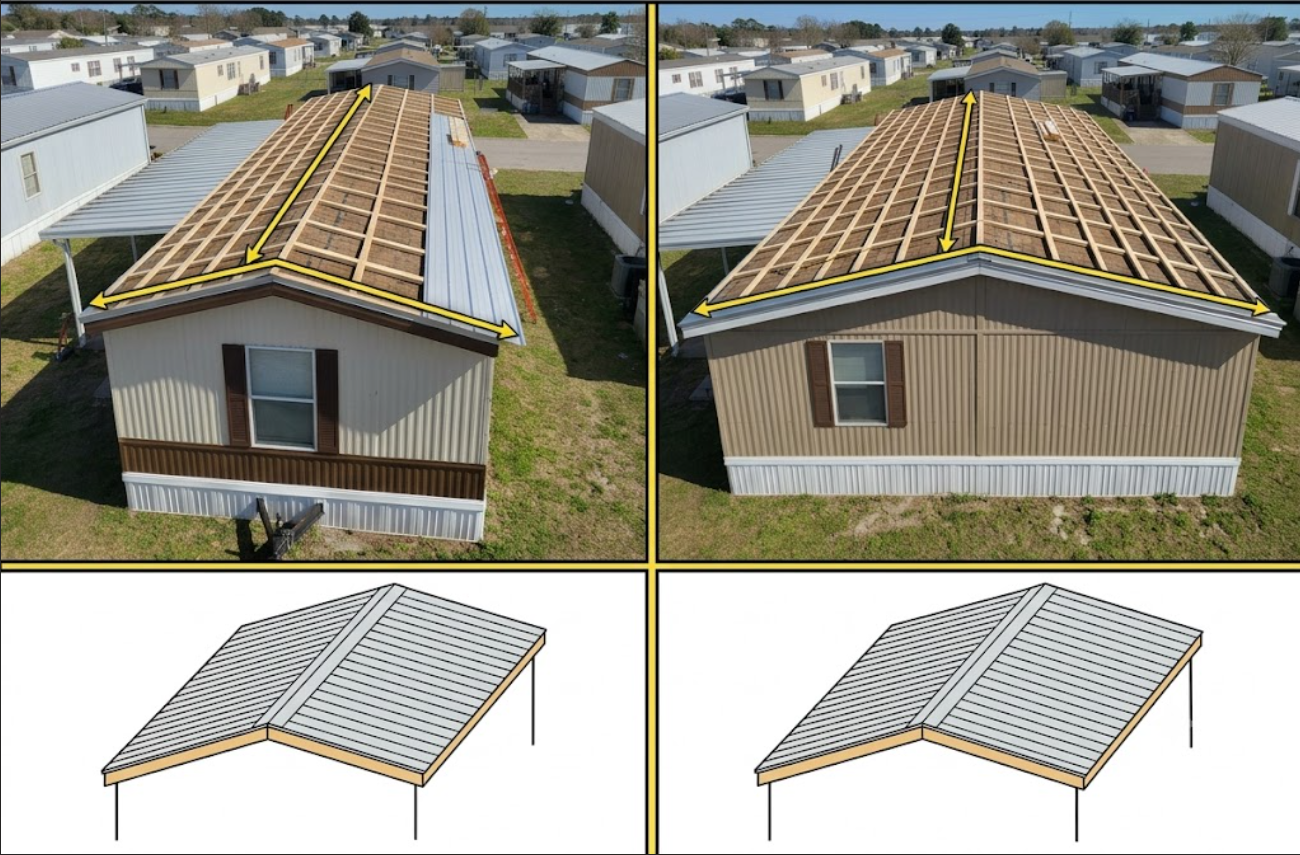
Section 1507.4.2 of the Florida Building Code requires 3:12 for lapped metal panels without lap sealant, 1/2:12 with sealant applied per the manufacturer’s instructions, and 1/4:12 for standing seam systems. Most manufactured homes built before the mid-1990s do not clear the first number, and plenty do not clear the second.
So the framing line appears, and it is not a small one. Purlins ripped to a taper, or stacked in courses, build a consistent plane across the width of the home, and tapered insulation does the same job at about $1.50 to $4 per square foot on its own, which gives you a sense of the order of magnitude even though the method differs.
Here is the part that surprises people: that framing cost lands across the same roof area as the covering itself, so it does not add ten percent to your project. It can add half again. Two identical single-wides, one at 3:12 and one at 1:12, will not get quotes within thousands of each other for the same panel.
Measure before you shop. Put a level and a tape on the roof, check the slope at three points across the width, and quote the shallowest reading rather than the friendliest one. If a contractor prices a metal roof for you without ever asking what your slope is, that number is a guess dressed up as an estimate.
Two worked examples
Single-wide, 14 by 70. About 980 square feet of footprint, call it 1,050 square feet of roof with the overhangs. A coating runs roughly $1,050 to $4,200. TPO runs roughly $4,200 to $10,500. An exposed-fastener metal re-cover runs roughly $5,250 to $12,600, and if the slope needs building, add to the top of that.
Double-wide, 28 by 60. About 1,680 square feet of footprint and roughly 1,750 square feet of roof. The same metal re-cover runs roughly $8,750 to $21,000.
The double-wide is roughly 67 percent bigger and costs roughly 67 percent more, which is the part everyone expects going in. What people do not expect is that the single-wide usually prices at a higher rate per square foot rather than a lower one.
Why small roofs cost more per square foot
Permit fees, mobilization, dump fees, and the minimum a crew will show up for do not shrink when the roof does. Spread across 1,750 square feet those fixed costs disappear into the total, but spread across 1,050 square feet they become a visible percentage of the bill.
This is also why the DIY path pencils out more often on these homes than on a house. Roof-over kits sold online run about $800 to $2,900 for a single-wide. We do not sell kits, and we will say plainly that for a straightforward single-wide with adequate slope, a kit is a reasonable purchase. What a kit does not give you is a panel matched to your actual slope, a Florida Product Approval that matches the assembly you are building, or trim cut to your dimensions. If you want those, send us the measurements and we will do a takeoff. Our posts on calculating how many panels you need and what a linear foot means in roofing will get you close on your own.
What will not help you pay for it
Two funding sources come up constantly in this conversation, and neither one applies.
The federal Energy Efficient Home Improvement Credit, Section 25C, covered 30 percent of qualifying insulation and materials up to $1,200 a year. The One Big Beautiful Bill Act terminated it for property placed in service after December 31, 2025. If you find a page still advertising that credit against a 2026 insulation or underlayment purchase, that page has not been updated since the law changed.
The My Safe Florida Home program does not cover mobile or manufactured homes. The program is limited to single-family site-built homes and townhouses carrying a homestead exemption, which excludes every HUD-code home built under the HUD Manufactured Home Construction and Safety Standards. RPS helps customers understand these programs; we do not approve anything, and we are not going to tell you a grant is coming when it is not.
What can help: Rule 15C-2.0081 requires that repair and remodeling on a manufactured home use material and design equivalent to the original construction, and some counties will want a design professional’s statement that the work does not lessen the home’s integrity. Budget for that letter rather than being surprised by it. Our post on paying for a new roof covers financing options that do apply.
Where metal is the wrong spend
If your roof sits below 1/2:12 and you are not willing to pay for the framing to fix that, metal is not the answer and we would rather you hear it from us than from an inspector. A TPO or rubber membrane is designed for exactly that condition, costs less per square foot, and will pass. Buying panels for a roof that cannot legally take them is the most expensive mistake in this entire article.
The other case is a home near the end of its practical life, where a metal roof priced at 40 years of service on a 1978 single-wide with a soft floor amounts to a 40-year roof on a five-year house. Sometimes an owner knows that and wants it anyway, which is a fair choice. Sometimes a coating for $2,000 is the correct answer and the honest one.
Frequently asked questions
How much does it cost to replace a mobile home roof in Florida?
Roughly $1,000 to $21,000 depending on covering and home size. A coating on a single-wide sits at the bottom, a framed metal re-cover on a double-wide at the top. Slope and framing move the number more than square footage does.
Is a roof-over cheaper than a full replacement?
Yes, by about $1 to $4 per square foot, which is the tear-off and disposal you skip. That saving only holds if the existing roof is dry and structurally sound underneath. Covering a wet roof buries the problem rather than fixing it.
What is the cheapest way to fix a mobile home roof?
An elastomeric coating at roughly $1 to $4 per square foot installed, and less if you apply it yourself. It buys 7 to 15 years on a roof that is basically sound. It does not repair a roof that leaks in several places.
Does homeowners insurance cover a mobile home roof replacement?
Only for covered sudden damage such as a storm, not for age or wear. Many Florida policies on older manufactured homes settle roof claims at actual cash value rather than replacement cost, which means depreciation comes out of the check. Read your roof settlement endorsement before you assume.
How long does a mobile home metal roof last?
Forty years and up when it is properly installed and maintained, with the finish warranty driving much of that. Galvalume carries 25 years and painted panels carry 40. Fastener maintenance on an exposed-fastener system is what decides whether you reach the top of that range.
Get a real number for your roof
Measure your slope at three points, get the length and width, and send them to us. We will run a free CAD takeoff and give you an itemized material cost for panels, trim, purlins, underlayment, and fasteners, so you can see what the material half of any contractor quote should look like. Most orders are ready for pickup in Welaka the next day. Call 386-222-6779.