

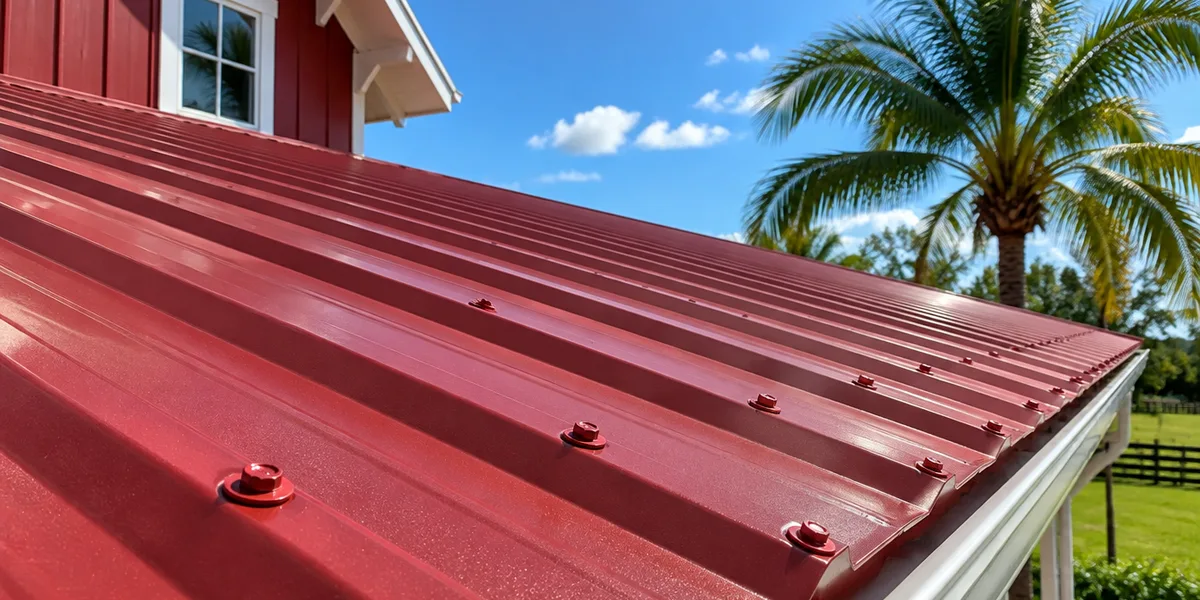
An exposed fastener metal roof is the right roof for most of the barns, workshops, porches, mobile homes and a good share of the houses we ship panels to from Welaka. The panel itself carries a 25- to 40-year finish warranty depending on coating, but the screws and washers holding it down are the shorter-lived part of the system, and on a roof that is going to last they get checked every few years and replaced when they tire. Standing seam earns its higher price on low slopes, near the coast, and for owners who want to stop thinking about the roof.
Key takeaways
- “Exposed fastener” means the screw goes through the face of the panel into the deck or purlin, with a sealing washer under the head. Super Pro 5 Rib, PBR and 5V all work this way. Pro-Loc hangs on hidden clips.
- FBC Section 1507.4.2 sets slope by seam type: lapped panels need 3:12 without lap sealant or ½:12 with it. Standing seam can go to ¼:12.
- Carbon steel grows about 6.5 millionths of an inch per inch per °F. On a 40-foot panel through a 100°F swing, that is roughly 5/16 inch of movement working against the screws.
- Finish warranties run 25 years for mill finish Galvalume, 40 for Valspar Weather XL (SMP), 30 for PVDF/Kynar. None of those numbers describe the fasteners.
- Both roof types can satisfy the roof covering line on the OIR-B1-1802 wind mitigation form when the roof is permitted and the panel carries a current Florida Product Approval.
What “exposed fastener” means on the roof
Picture a 5 Rib panel going onto a pole barn outside Interlachen. The installer laps it over the panel beside it, sets a self-drilling screw with a metal cap and a rubber washer on the flat, and drives it through the steel into the purlin below, where the head sits in plain view for the life of the roof. Even a small barn carries screws by the hundreds.
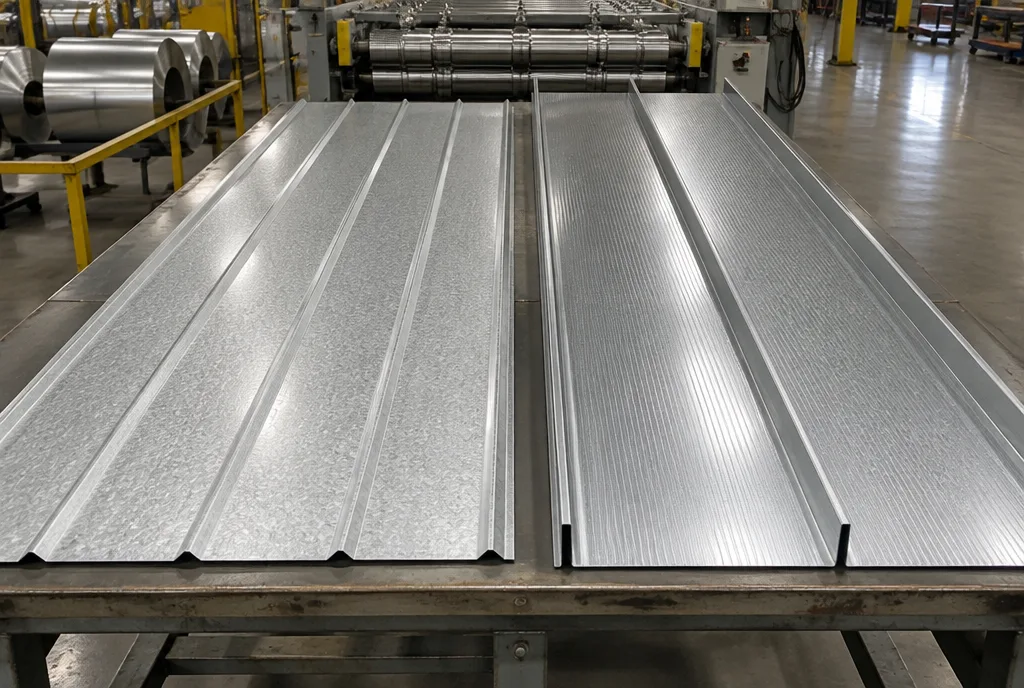
Three of our four roof panels work this way. Super Pro 5 Rib is the ag-panel profile: 36 inches of coverage, five ¾-inch ribs on 9-inch centers, 29 or 26 gauge. Super Pro PBR is the heavier structural panel, 1¼-inch ribs on 12-inch centers, 26 gauge (24 on request), for longer spans over open framing. Super Pro 5V is the crimp panel, 26 and 24 gauge.
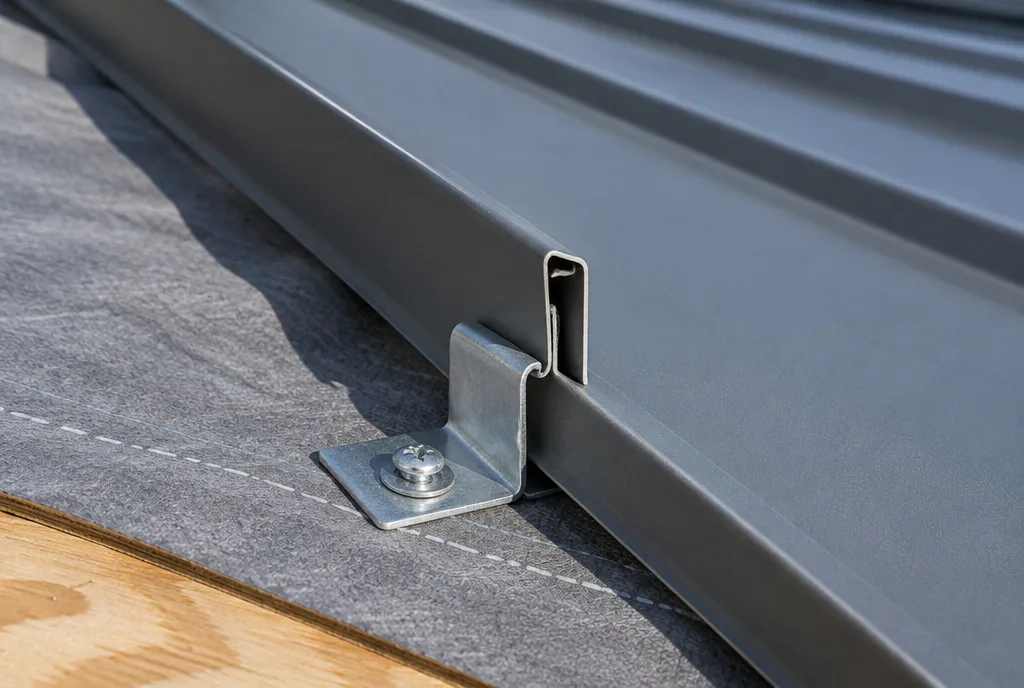
Pro-Loc Standing Seam is the exception: a 16-inch striated panel in 26 or 24 gauge steel or .032 aluminum with nothing through its face. A clip screws to the plywood deck, the seam locks over the clip, the next panel locks over that, and the screws end up buried where sun and rain never touch them while the panel stays free to slide on the clip as it heats and cools.
That is the whole distinction. Where the screw goes.
Why the screw is the maintenance item
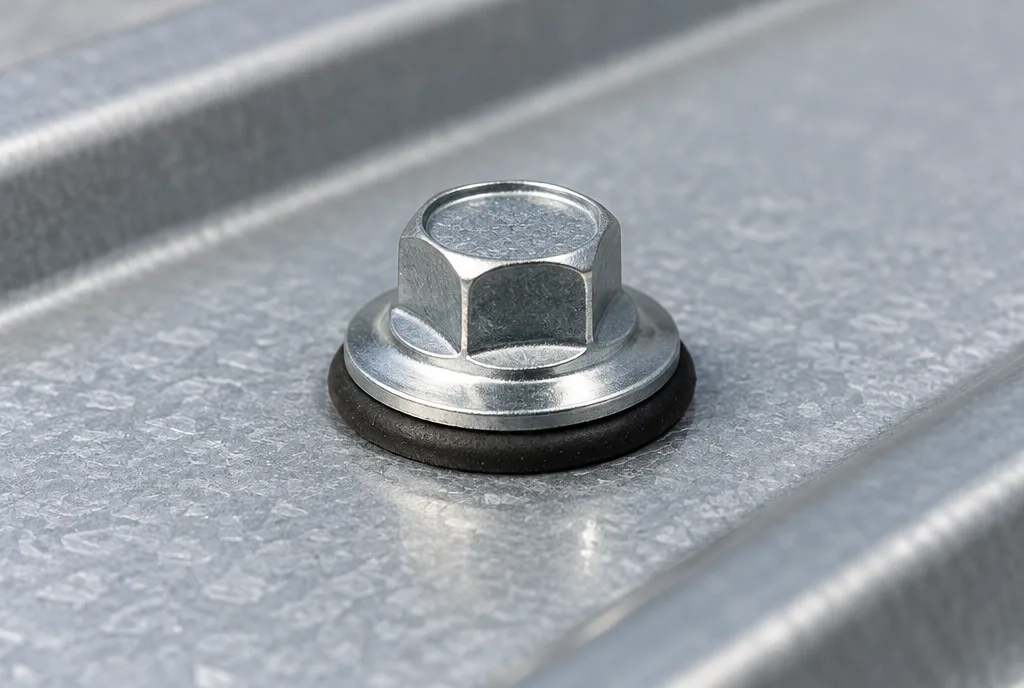
A panel does not wear out like a shingle. Steel coated to ASTM A792 AZ50, with an SMP or PVDF paint system baked over it, sits on a Putnam County roof for decades with little change beyond the slow fade every painted surface in Florida goes through. The rubber washer under each screw head changes faster.
That washer is all that stands between a hole in your roof and the rain. Rubber that spends every Florida afternoon under direct sun slowly hardens, shrinks and cracks, and once a washer has lost its squish it no longer presses against the panel the way it did the day it was driven. The screw is still tight. The roof looks fine. Water gets in anyway. Our post on how long screws last on a metal roof covers the signs.
Then there is movement. Carbon steel expands at about 6.5 × 10⁻⁶ inches per inch per °F, so a 40-foot panel, 480 inches of it, run through a 100°F swing between a January morning in Putnam County and a dark panel in August, grows and shrinks about 0.31 inches. Call it 5/16. Every day.
On standing seam the panel floats on its clips. On an exposed fastener roof the panel is pinned at every screw, so the movement works against the fastener, and over thousands of heating and cooling cycles a screw can loosen, back out a thread at a time, or wallow its hole into an oval the washer can no longer cover. Longer panels move more. Darker colors move more.
The third problem gets settled on day one: how the screw was driven. Over-driven, the washer splits. Under-driven, it never compresses. Angled, one side seals and the other does not. The fix is a depth-sensing driver set once at the start of the job and left alone, plus a crew that puts screws where the panel wants them instead of wherever the last one happened to land. Our screw placement guide covers flat-versus-rib and spacing.
We have seen decades-old 5V come off Crescent City houses with the panel still sound, and in almost every case it came off because of fasteners nobody had looked at since the day the roof went on.
How long an exposed fastener roof lasts
Nobody can give you one number. Be suspicious of anyone who does.
The finish warranty on our panels runs 25 years for mill finish Galvalume, 40 years for Valspar Weather XL (SMP) painted steel, and 30 years for PVDF/Kynar, and the Weather XL warranty excludes substrates within 1,500 feet of salt water, which rules out a lot of Flagler and Volusia beachfront. Those are finish warranties. They say nothing about screws.
Inland, a properly installed panel tends to outlast its first set of washers, and often its second. A roof that gets a fastener check every few years can run for decades, depending on the coating, how much sun and salt it sees, and whether anyone ever walked on it in the wrong boots or dragged a ladder across it. A roof nobody looks at leaks at a handful of screws long before the panel is done, and the owner blames the metal.
Standing seam removes that variable. With no face fasteners to age, the limiting factors become the coating and the flashing at penetrations, and a Pro-Loc roof over plywood on a house in Palatka is, for practical purposes, a roof you install once. That is the honest case for paying more. Exposed fastener roofs do not fail on their own. They ask something of you.
Slope, cost and looks
Slope is a hard line. The 2023 Florida Building Code, Building, Section 1507.4.2 (Deck slope) sets minimums by seam type: lapped, nonsoldered seam panels without lap sealant need 3:12; with applied lap sealant, ½:12; standing seam systems, ¼:12. The code is reachable through Florida Building Code Online.
On a real house, a 2:12 porch on the back of a block ranch in Satsuma is a standing seam porch, or an exposed fastener porch with sealant down every side lap and a close eye on the screws. A 4:12 main roof takes anything we make.
Section 1507.4.4 (Attachment) governs what holds the panel down: the fasteners in the manufacturer’s approved instructions, or, absent those, galvanized on steel, stainless on any metal roof, aluminum on aluminum. Mix metals at the screw and you get a rust ring around every head.
Cost favors exposed fastener. Fewer, wider panels. No clips. Screwing a 36-inch panel down goes faster than clipping and locking a 16-inch one, more crews in our counties know how to do it well, and the trim that goes with it is simpler to cut and fit. Our 2026 Florida metal roof cost breakdown has numbers.
Looks are taste, with one Florida wrinkle. 5V crimp sat on cracker houses and fish camps along the St. Johns for generations, and on a Putnam County bungalow it reads as right in a way standing seam sometimes does not. Standing seam reads cleaner. Neither is wrong.
| Exposed fastener (5 Rib, PBR, 5V) | Standing seam (Pro-Loc) | |
|---|---|---|
| How it attaches | Screw through the panel face, sealing washer under the head | Clip screwed to deck, panel seam locks over clip |
| Code minimum slope (FBC 1507.4.2) | 3:12 without lap sealant, ½:12 with it | ¼:12 |
| Deck | Plywood, 1x4s over OSB, or purlins | Plywood |
| Coverage width and gauges | 36 in. for 5 Rib and PBR; 29 to 24 ga. by panel | 16 in.; 26 or 24 ga. steel, .032 aluminum |
| Thermal movement | Resisted at every screw | Panel floats on clips |
| Maintenance item | Washers and screws, checked every few years | Flashing and penetrations |
| Material and labor cost | Lower | Higher |
| Typical fit | Barns, shops, mobile homes, porches, budget-minded houses | Low slope, coastal, long runs, long-horizon owners |
Insurance: the form does not ask which panel you bought
Wind mitigation credits run through the Florida Office of Insurance Regulation’s Uniform Mitigation Verification Inspection Form, OIR-B1-1802. The revised OIR-B1-1802 (Rev. 04/26) is required for inspections performed on or after April 1, 2026.
The roof covering section asks whether the covering was permitted and meets the Florida Building Code with a current product approval, not which profile it is. A 5 Rib roof installed under permit with a listed approval checks the same box as a Pro-Loc roof, because the form’s other roof sections, deck attachment and roof-to-wall attachment, are about what sits under the panel rather than the panel itself. Our Florida Product Approval codes page lists each panel’s approved configurations, and the state’s Product Approval system is where inspectors look.
F.S. 627.0629 requires insurers to offer actuarially reasonable discounts for construction features that improve roof covering performance and wind resistance. What that is worth varies by carrier and by what else the inspector finds, so ask your agent for the credit schedule before you count on a number.
Where we steer people, and where we do not
We make more exposed fastener panel than hidden fastener panel, and that is no accident, because the barns, shops, fish camps and block houses that fill our 15 counties mostly want a roof that is affordable, forgiving to install, and fixable with a box of screws.
5 Rib, PBR or 5V when: the building is agricultural or a workshop; the roof goes over purlins instead of a solid deck; it is a mobile home roof-over, where weight and cost both matter; it is a carport, outbuilding or dock roof; the property is remote and a bucket of replacement screws every decade is a reasonable plan; or the budget has a ceiling. A 12-by-16 shed in Keystone Heights does not need standing seam.
Pro-Loc when: the slope is under 3:12 and the owner does not want to live on lap sealant; the house is within a few miles of the Atlantic, where salt and wind punish every exposed washer; the panel runs are 30 feet and up, where thermal movement does real work on screws; the roof will get walked on for AC service or solar; or the owner plans to stay 30 years.
One more case, against our own interest: a roof flatter than ¼:12 should not be metal at all, since the code allows no metal panel below that slope. A membrane roof is the right answer.
Installation quality outranks all of this. A crew that over-drives every screw hands you a leaky exposed fastener roof in three years, and a crew that skips clips to save an afternoon hands you a standing seam roof that oil-cans in the first summer and lifts in the first storm. Pick the installer as carefully as the panel.
A maintenance schedule a homeowner can keep
They do not need much. They need something.
-
Once a year, after hurricane season. NOAA’s Atlantic season ends November 30. In early December, walk the perimeter with binoculars. Look for screw heads sitting proud of the panel, chalky or split washers, and rust rings around heads.
-
Every 3 to 5 years, get on the roof or send someone. Press on a sample of screws. A screw that turns easily or a washer with no give gets replaced. If a good share are tired, replace them all with the next size up so the new threads bite fresh wood.
-
After any named storm. Check ridge caps, gable trim and eave closures, where wind gets a grip first.
-
Keep debris off. Pine needles in a lap joint hold water against the panel’s most vulnerable spot.
Standing seam gets the same yearly look, aimed at pipe boots and wall flashing.
Frequently asked questions
How long does an exposed fastener metal roof last in Florida?
The panel finish carries a 25-, 30- or 40-year warranty depending on coating. The screws and washers are the shorter-lived part and should be checked every few years. With that upkeep, properly installed inland roofs commonly outlast their first set of fasteners.
Do exposed fastener metal roofs leak?
Not when the screws are driven right and the washers are intact. Leaks almost always trace to a washer that aged out, a screw that backed out from thermal movement, or a screw driven crooked on day one. All three are fixable with a driver and a box of replacement screws.
Is standing seam worth the extra cost in Florida?
On slopes under 3:12, near the coast, on long panel runs, on roofs that get walked on, and for owners who plan to stay 30 years, yes. On a 4:12 workshop or a barn over purlins, the extra money buys very little, and we will tell you so.
Can an exposed fastener roof go on a low-slope porch?
FBC Section 1507.4.2 allows lapped panels down to ½:12 with lap sealant, and 3:12 without it. Below ¼:12, the code allows no metal panel. On a 1:12 or 2:12 porch we usually recommend Pro-Loc, because sealant on a lapped panel is one more thing to maintain.
Is 5V crimp an exposed fastener roof?
Yes. Super Pro 5V screws through the face of the panel like 5 Rib and PBR. The crimped ribs are a profile, not a fastening system. It is approved over plywood and purlins in 26 and 24 gauge for residential and agricultural buildings.
Price it both ways before you decide
Send us the address. Our free CAD takeoff service measures the roof from aerial imagery and returns a material report in under 48 hours, and if you ask, we will run it twice: once in 5 Rib, PBR or 5V, once in Pro-Loc. You see the panel count, the trim and the price gap before anyone climbs a ladder. Call the Welaka counter at 386-222-6779 or email sales@rpsmetalroofing.com.