

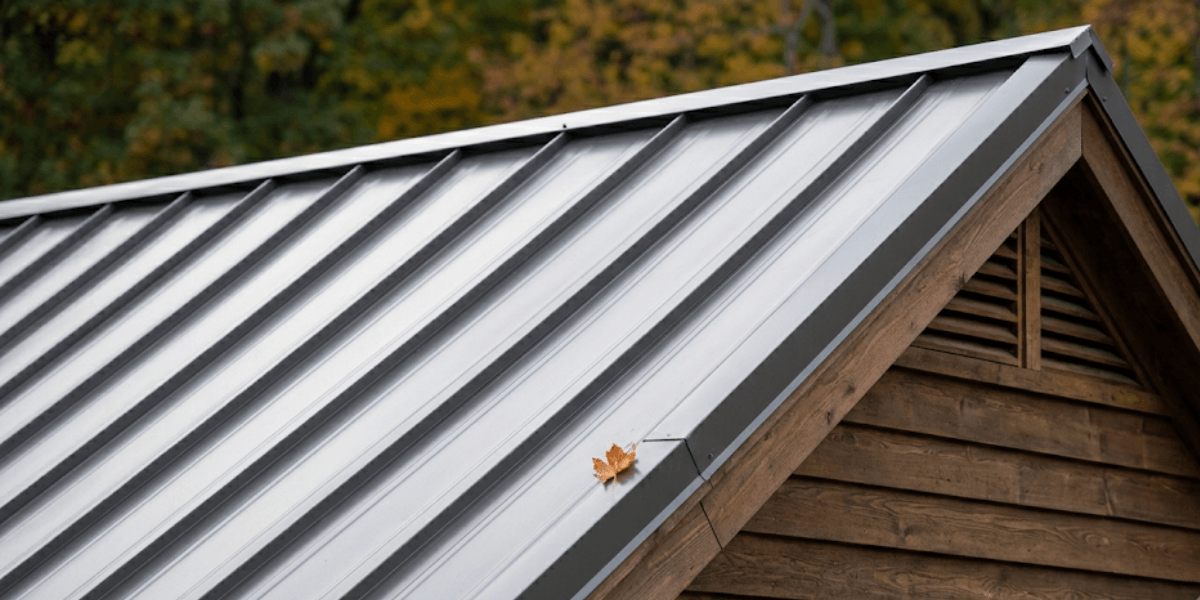
The rake of a roof is the sloped edge of a gable roof running from the ridge (peak) down to the eave (bottom horizontal edge). It’s the angled outline you see when you look at the side of a house with an A-frame or pitched roof. The rake is a real architectural feature that matters for water management, wind resistance, and how the roof edge holds up in a hurricane.
There’s a second thing called a “roof rake” — a long-handled snow removal tool used to pull accumulated snow off a roof from ground level. Florida homes don’t need that tool. This post is about the first meaning: the structural rake edge on your roof and why it matters for Florida homes specifically. If you were searching for snow-removal information, you can safely skip the rest of this post.
Key takeaways
- The rake is the sloped edge of a gable roof, running from the ridge to the eave along the gable end. Every gable roof has two rakes (one on each side).
- The rake is a wind-uplift attack point. In hurricanes and severe storms, wind loads concentrate at roof perimeter zones — eaves, ridges, and rakes — with the highest forces at corners.
- Florida Building Code Section R905.2.8.5 requires drip edge (including rake edge) mechanically fastened at 12 inches on center standard, or 4 inches on center where design wind speed (Vasd) is 110 mph or higher or mean roof height exceeds 33 feet. Most of Florida triggers this requirement.
- In the HVHZ (Miami-Dade, Broward), fastener spacing at rake edges tightens further, and all components must be tested to Florida Product Approval or Miami-Dade Notice of Acceptance standards.
- RPS forms rake (gable) trim from the same coil stock as its metal roof panels, matching gauge, finish, and color for both durability and appearance.
Anatomy of the rake edge
The rake edge is not a single component. It’s an assembly of pieces that work together to seal the sloped edge of a gable roof against wind, water, and pests.
Rake board. The exposed board that runs along the outside face of the rake, from ridge to eave. It covers the edge of the roof deck and the top edge of the siding or brick beneath. Rake boards can be dimensional lumber (pine, cedar), engineered material (composite, PVC), or wrapped in metal to match a metal roof.
Rake fascia. Positioned beneath the roof overhang on rakes with overhang designs, the rake fascia covers the ends of the rafters or trusses and stabilizes the edge structure. Not all rake designs have a separate fascia; on flush (no-overhang) rakes, the rake board serves both purposes.
Rake trim (gable trim). The metal flashing that finishes the edge where the roof panel meets the rake board. On metal roofs, this is where the panel edge terminates. Rake trim covers the exposed panel edge, seals the joint between the panel and the rake board, and creates the finished appearance of the gable end. RPS forms rake trim in the same substrate and finish as the panels.
Soffit (on overhanging rakes). The underside of the rake overhang, running from the outside face of the rake board back to the exterior wall. Soffit panels can be vented (contributing to attic airflow) or solid (aesthetic only).
Drip edge at the rake. A separate piece of metal flashing that installs at the rake edge over the underlayment, directing water off the deck edge. FBC treats rake drip edge and eave drip edge as the same category of “metal profile” with the same fastening requirements.
The rake assembly works as a system. Missing or damaged pieces at any point create a water intrusion pathway.
Why the rake edge matters more in Florida
Three Florida-specific factors make the rake a more critical detail here than in most of the country.
Wind uplift concentrates at roof perimeters. Aerodynamic pressure on a roof during a hurricane isn’t uniform. Wind flowing over the roof accelerates at the edges, creating negative pressure (suction) that’s strongest at corners, then along the perimeter zones (including rakes), and lowest in the field of the roof. This is why FBC and ASCE 7 both specify progressively tighter fastener schedules from field to perimeter to corner. In a 130 mph design wind event, the uplift force on a corner or rake edge can be 2 to 3 times the force on the roof field.
Salt-air corrosion accelerates rake trim failure. Coastal Florida homes within 1,500 feet of salt water experience faster corrosion of exposed metal edge components. The Valspar Weather XL 40-year finish warranty carries a 1,500-foot coastal exclusion for coated steel substrates. Aluminum substrate rake trim is the recommended coastal solution because aluminum doesn’t rust regardless of salt exposure.
Hurricane debris damage often starts at the rake. Wind-driven debris (branches, palm fronds, pieces of other roofs) tends to strike sloped edges before it reaches horizontal surfaces. A damaged rake trim piece opens the panel edge to wind uplift and driven rain, which then propagates across the roof. Insurers and Florida contractors both recognize the rake as a common first-failure point in post-hurricane inspections.
Florida Building Code requirements for rake edge attachment
The 2023 Florida Building Code, 8th Edition, effective December 31, 2023, sets specific requirements for drip edge (including rake edge) attachment:
- Standard fastener spacing: maximum 12 inches on center.
- High-wind exception: where the design wind speed (Vasd, per Section R301.2.1.3) is 110 mph or higher, or the mean roof height exceeds 33 feet, drip edges must be fastened at maximum 4 inches on center.
- Overlap: minimum 3 inches at adjacent pieces.
- Underlayment interface: at rakes, drip edge installs over the underlayment; at eaves, over or under with specific conditions.
The high-wind exception covers essentially all of Florida. Florida design wind speeds run from roughly 130 mph in the northern parts of the state to 180+ mph in the HVHZ. Almost every Florida residential rake will require the 4-inch fastener spacing, not the standard 12-inch.
HVHZ (Miami-Dade, Broward) additional requirements. Roof edge metal in the HVHZ must carry a Miami-Dade Notice of Acceptance or Florida Product Approval covering HVHZ installation specifically. Fastener types, spacing, and edge distances are set by the approved product’s installation instructions and are typically tighter than 4 inches on center at corners.
The FBC treats gable drip and rake edge metal as the same category as eave drip edge, meaning the same fastening rules apply. What changes is that on a rake, the effect of an under-fastened piece is more consequential because rakes take higher uplift than eaves.
Materials for Florida rake trim
Three practical material choices for Florida rake trim, ordered by durability in local conditions:
Aluminum. Best for coastal Florida (within 1,500 feet of salt water). Naturally corrosion-resistant, doesn’t rust regardless of finish condition. RPS offers .032 aluminum rake trim matched to aluminum standing seam and 5V panel systems. Cost premium of roughly 80 to 100% over Galvalume substrate, but warranted for coastal exposure.
Galvalume-substrate steel. The standard inland Florida choice. Combines a 55% aluminum, 43.4% zinc, 1.5% silicon coating on steel substrate for corrosion resistance in non-coastal environments. RPS forms Galvalume rake trim in matching gauge and finish to Super Pro 5V, 5 Rib, PBR, and Pro Loc Standing Seam panels.
PVC or composite. Occasionally used on shingle-roof installations where the rake trim is not metal-clad. Not typical on metal roof installations. If a PVC rake board is used behind a metal rake trim, the PVC handles moisture-resistance and the metal handles the visible edge finish.
Materials to avoid in Florida. Bare pine or cedar for the rake board without a metal wrap or PVC replacement. Wood rots quickly in Florida humidity and holds moisture against the underlying structure. If the rake board itself is wood, it should be sealed and wrapped in metal that matches the roof.
Common rake failures on Florida homes
Four patterns account for most rake edge failures on Florida homes.
Wind uplift after a hurricane. Rake trim that was fastened at 12-inch spacing (instead of the 4-inch spacing required for high-wind zones) is a common source of storm damage. The trim pulls loose during the event, which exposes the panel edge to further uplift. This is the classic “improperly installed rake” failure and usually traces back to the original installation not meeting FBC high-wind requirements.
Fascia rot from moisture intrusion. When rake trim loosens over time (from thermal cycling, poor initial fastening, or aging sealant), water enters behind the trim and rots the underlying fascia board or rake board. By the time the exterior damage is visible, the underlying wood may be significantly compromised.
Salt-air corrosion on coastal jobs. Coastal rake trim installed in Galvalume substrate (rather than aluminum) shows corrosion at the fastener heads and along cut edges within 5 to 10 years. Once corrosion starts, it propagates along the trim length faster than most homeowners realize.
Pest entry through rake gaps. Small gaps at rake-to-soffit intersections or at rake-to-ridge terminations become entry points for bats, birds, wasps, and insects. Attic pest infestations often start at the rake edge before the homeowner notices anything from the ground.
RPS gable trim for metal roof applications
RPS forms gable (rake) trim from the same coil stock as its metal roof panels. Standard options include:
- Substrate: Galvalume (26G or 24G) for inland Florida, aluminum (.032) for coastal Florida within 1,500 feet of salt water.
- Finish: Valspar Weather XL painted finish (40-year warranty inland), PVDF/Kynar 500 for premium and coastal applications, or mill Galvalume for utility and agricultural work.
- Color: matched to the panel palette (Bone White, Saddle Tan, Charcoal Gray, Rustic Red, Colony Green, and the full Pro Loc Standing Seam palette).
- Profile: matched to the panel system (Super Pro 5V, 5 Rib, PBR, Pro Loc Standing Seam) with correct dimensions for the panel’s edge condition.
Ordering rake trim from the same manufacturer as the panels means matching substrate, matching finish, matching color, and consistent gauge — which eliminates galvanic corrosion risk and the visual mismatch of piecing together edge metal from different suppliers.
What to do next
If you’re installing a new metal roof and want the rake trim specification pulled as part of the takeoff, our team in Welaka includes gable trim in every CAD takeoff we produce. We calculate the linear footage of eaves and rakes, recommend the trim profiles, and specify the substrate and finish for your location (including the coastal aluminum recommendation within 1,500 feet of salt water).
If you’re inspecting an existing Florida metal roof after a storm and see damaged, loose, or missing rake trim, address it before the next storm arrives. Rake trim replacement is straightforward as long as the underlying rake board and fascia are still sound.
Request a free CAD takeoff at rpsmetalroofing.com or call 386-222-6779.
Frequently Asked Questions
Is a roof rake the same as an eave?
No. The rake is the sloped edge of a gable roof running from ridge to eave. The eave is the horizontal lower edge where the gutter typically attaches. Every gable roof has both. The rake follows the roof pitch; the eave runs parallel to the ground.
Do all roofs have rakes?
No, only gable roofs (and gable variations like Dutch gables and cross-gables) have rakes. Hip roofs have all horizontal eaves and no rakes. Flat roofs have no rakes. Shed roofs have one rake at the high end and one eave at the low end.
What’s the difference between a rake board and rake trim?
The rake board is the flat board (wood, composite, PVC, or metal-wrapped) that runs along the rake edge covering the top of the siding or brick. Rake trim is the metal flashing that finishes the edge where the roof panel meets the rake board, sealing the joint and covering the panel edge.
Does Florida code require rake edge drip metal?
Yes. FBC R905.2.8.5 requires drip edge at eaves and rakes for shingle roofs. For metal roofs, edge metal requirements are set by the panel system’s Florida Product Approval and the manufacturer’s installation instructions. In both cases, rake edge metal is required, not optional.
What fastener spacing does Florida require for rake edge metal?
Standard 12 inches on center, tightened to 4 inches on center where the design wind speed (Vasd) is 110 mph or higher or the mean roof height exceeds 33 feet. Most Florida residential roofs meet at least one of these conditions, making 4-inch fastener spacing the practical default statewide. In the HVHZ (Miami-Dade, Broward), the product-specific NOA sets the exact spacing, typically tighter than 4 inches at corners.
Should I paint my rake board a different color than my roof?
Design preference, but consider that a metal-wrapped or metal-trimmed rake matched to the panel color creates a cleaner, more finished look. Contrasting colors highlight the rake as an architectural feature and can work well on certain styles (Florida Cracker, coastal contemporary). Matching colors read as intentional and simple.
Can I replace damaged rake trim myself?
For a single-story home with straightforward access, replacing a section of damaged rake trim is a manageable DIY project if you have the matching material and safe ladder access. For two-story homes, HVHZ installations, or any damage that extends into the underlying rake board or fascia, hire a metal roofing contractor. The consequences of a poorly-installed rake trim in a hurricane are worse than the labor cost of professional installation.